Ch.5 - Thermochemistry
Brown - Chemistry: The Central Science 15th Edition
Brown15th EditionChemistry: The Central ScienceISBN: 9780137542970Not the one you use?Change textbook
Chapter 5, Problem 82b

Methanol (CH3OH) is used as a fuel in race cars. (b) Calculate the standard enthalpy change for the reaction, assuming H2O(g) as a product.

Verified step by step guidance
1
Determine the balanced chemical equation for the combustion of methanol (CH_3OH). The general form is: CH_3OH(l) + O_2(g) -> CO_2(g) + H_2O(g).
Balance the equation by ensuring the number of atoms of each element is the same on both sides. For methanol combustion, it becomes: 2 CH_3OH(l) + 3 O_2(g) -> 2 CO_2(g) + 4 H_2O(g).
Use standard enthalpy of formation values (ΔH_f^°) for each compound involved in the reaction. These values are typically found in a table of thermodynamic data.
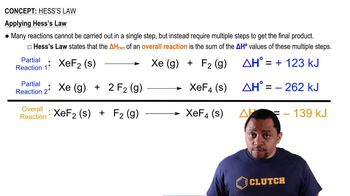
Apply Hess's Law to calculate the standard enthalpy change (ΔH_rxn^°) for the reaction: ΔH_rxn^° = [Σ ΔH_f^°(products)] - [Σ ΔH_f^°(reactants)].
Substitute the ΔH_f^° values into the equation and perform the arithmetic to find the standard enthalpy change for the reaction.

Verified video answer for a similar problem:

This video solution was recommended by our tutors as helpful for the problem above.
Video duration:
5m
Was this helpful?

Key Concepts

Here are the essential concepts you must grasp in order to answer the question correctly.

Standard Enthalpy Change

Standard enthalpy change (ΔH°) refers to the heat change that occurs at constant pressure when one mole of a substance is formed from its elements in their standard states. It is a crucial concept in thermodynamics, allowing chemists to predict the energy changes associated with chemical reactions. This value is typically measured in kilojoules per mole (kJ/mol) and is essential for calculating the energy released or absorbed during a reaction.

Combustion Reactions

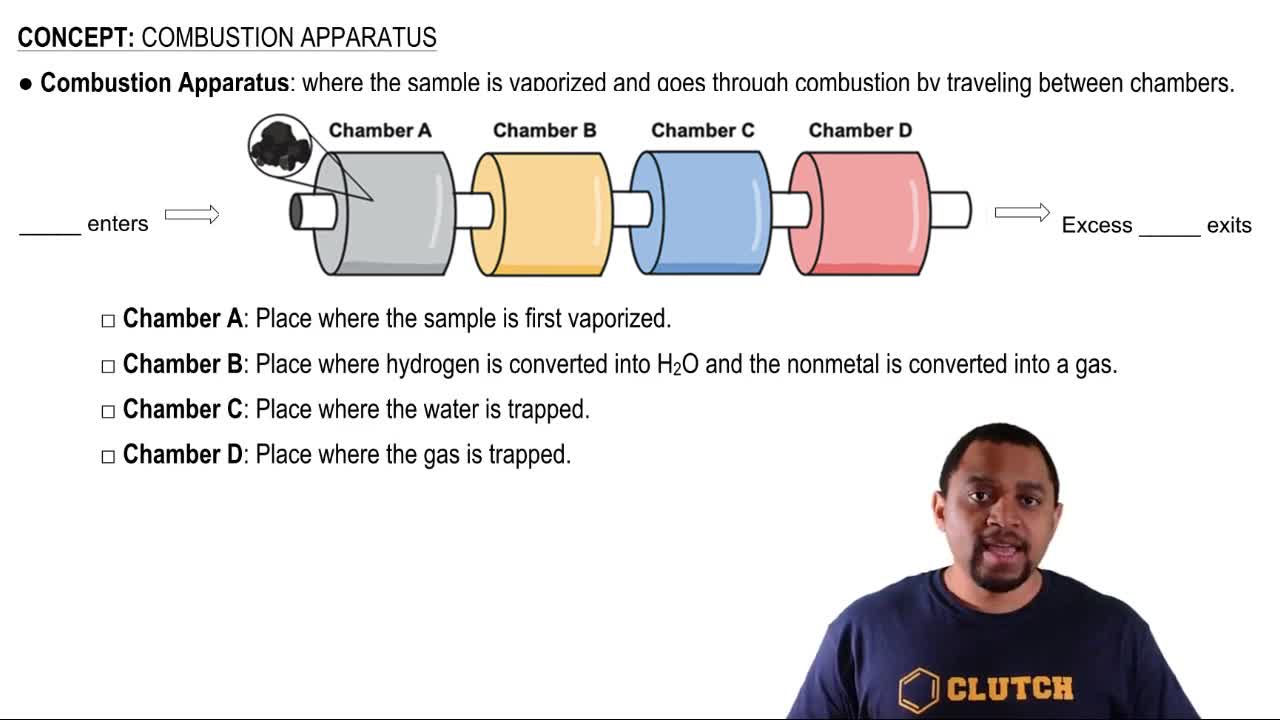
Combustion reactions involve the reaction of a substance with oxygen, producing heat and light. In the case of methanol (CH₃OH), its combustion with oxygen yields carbon dioxide (CO₂) and water (H₂O) as products. Understanding the stoichiometry of combustion reactions is vital for calculating the enthalpy change, as it allows for the determination of the amount of reactants and products involved in the reaction.
Recommended video:
Guided course
02:24
Combustion Apparatus

Hess's Law

Hess's Law states that the total enthalpy change for a reaction is the sum of the enthalpy changes for the individual steps of the reaction, regardless of the pathway taken. This principle is useful for calculating the standard enthalpy change of a reaction when direct measurement is difficult. By using known enthalpy values of related reactions, one can derive the enthalpy change for the desired reaction, such as the combustion of methanol.
Recommended video:
Related Practice
Textbook Question

Ethanol (C2H5OH) is blended with gasoline as an automobile fuel. (d) Calculate the mass of CO2 produced per kJ of heat emitted.

740
views

Textbook Question

Methanol (CH3OH) is used as a fuel in race cars. (c) Calculate the heat produced by combustion per liter of methanol. Methanol has a density of 0.791 g/mL.

905
views
Textbook Question

Ethanol (C2H5OH) is blended with gasoline as an automobile fuel. (c) Calculate the heat produced per liter of ethanol by combustion of ethanol under constant pressure. Ethanol has a density of 0.789 g/mL.

917
views
Textbook Question

Ethane, C2H6, is an alkane with one C─C bond and six C─H bonds (Section 2.9). a. Use enthalpies of formation given in Appendix C to calculate Δ𝐻 for the reaction C2H6(𝑔)→2C(𝑔)+6H(𝑔). b. Use the result from part (a) and the value of 𝐷(C─H) from Table 5.4 to estimate the bond enthalpy 𝐷(C─C). c. How large is the difference between the value calculated for in part (b) and the value given in Table 5.4?

Textbook Question

Methanol (CH3OH) is used as a fuel in race cars. (d) Calculate the mass of CO2 produced per kJ of heat emitted.

461
views
Textbook Question

Gasoline is composed primarily of hydrocarbons, including many with eight carbon atoms, called octanes. One of the cleanest–burning octanes is a compound called 2,3,4- trimethylpentane, which has the following structural formula: The complete combustion of one mole of this compound to CO2(g) and H2O(g) leads to ΔH° = -5064.9 kJ. (b) By using the information in this problem and data in Table 5.3, calculate H°f for 2,3,4-trimethylpentane.

1204
views