Using Heisenberg’s uncertainty principle, calculate the uncertainty in the position of b. a proton moving at a speed of (5.00±0.01) × 104 m/s. The mass of a proton is 1.673×10⁻²⁷ kg.
Ch.6 - Electronic Structure of Atoms

Brown15th EditionChemistry: The Central ScienceISBN: 9780137542970Not the one you use?Change textbook
Chapter 6, Problem 55a
(a) For n = 4, what are the possible values of l?
Verified step by step guidance1
insert step 1> Identify the principal quantum number (n) given in the problem, which is n = 4.
insert step 2> Recall that the azimuthal quantum number (l) can take integer values from 0 to n-1.
insert step 3> Calculate the possible values of l by substituting n = 4 into the range 0 to n-1, which gives 0, 1, 2, and 3.
insert step 4> Understand that each value of l corresponds to a different type of orbital: l = 0 (s orbital), l = 1 (p orbital), l = 2 (d orbital), and l = 3 (f orbital).
insert step 5> Conclude that for n = 4, the possible values of l are 0, 1, 2, and 3, representing the s, p, d, and f orbitals respectively.

Verified video answer for a similar problem:
This video solution was recommended by our tutors as helpful for the problem above.
Video duration:
55sWas this helpful?
Key Concepts
Here are the essential concepts you must grasp in order to answer the question correctly.
Quantum Numbers
Quantum numbers are a set of numerical values that describe the unique quantum state of an electron in an atom. They include the principal quantum number (n), azimuthal quantum number (l), magnetic quantum number (m_l), and spin quantum number (m_s). Each quantum number provides specific information about the electron's energy level, shape, orientation, and spin.
Recommended video:
Guided course
Principal Quantum Number
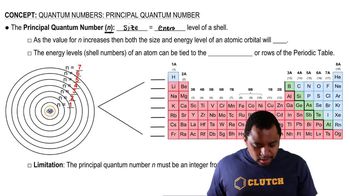
Principal Quantum Number (n)
The principal quantum number (n) indicates the main energy level or shell of an electron in an atom. It can take positive integer values (1, 2, 3, ...), with higher values corresponding to electrons that are further from the nucleus and have higher energy. In this case, n = 4 signifies the fourth energy level.
Recommended video:
Guided course
Principal Quantum Number
Azimuthal Quantum Number (l)
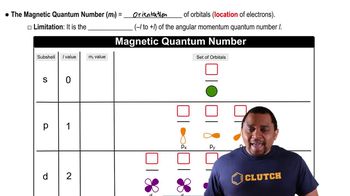
The azimuthal quantum number (l) defines the shape of the electron's orbital and can take on integer values from 0 to (n-1). For n = 4, the possible values of l are 0, 1, 2, and 3, which correspond to the s, p, d, and f orbitals, respectively. This concept is crucial for understanding the distribution of electrons in an atom.
Recommended video:
Guided course
Magnetic Quantum Number
Related Practice
Textbook Question
1
views
Textbook Question
A certain orbital of the hydrogen atom has n = 4 and l = 2. a. What are the possible values of ml for this orbital?
2
views
Textbook Question
How many unique combinations of the quantum numbers l and 𝑚𝑙 are there when b. n = 4?
4
views
Textbook Question
Give the values for n, l, and 𝑚𝑙 for a. each orbital in the 2p subshell
2
views
Textbook Question
Using Heisenberg's uncertainty principle, calculate the uncertainty in the position of (a) a 1.50-mg mosquito moving at a speed of 1.40 m/s if the speed is known to within {0.01 m/s;
1438
views
Textbook Question
Calculate the uncertainty in the position of (a) an electron moving at a speed of 13.00 ± 0.012 × 10⁵ m/s (b) a neutron moving at this same speed. (The masses of an electron and a neutron are given in the table of fundamental constants in the inside cover of the text.)
900
views
1
rank