

Ch.6 - Electronic Structure of Atoms
Brown - Chemistry: The Central Science 15th Edition
Brown15th EditionChemistry: The Central ScienceISBN: 9780137542970Not the one you use?Change textbook
Chapter 6, Problem 88a

In an experiment to study the photoelectric effect, a scientist measures the kinetic energy of ejected electrons as a function of the frequency of radiation hitting a metal surface. She obtains the following plot. The point labeled 'n0' corresponds to light with a wavelength of 542 nm. (a) What is the value of n0 in s - 1?
Graph showing electron kinetic energy vs frequency, with point 'n0' at 542 nm wavelength.

Verified step by step guidance
1
Identify the given wavelength (λ) of light, which is 542 nm.
Convert the wavelength from nanometers to meters by multiplying by 10^-9.
Use the speed of light equation, c = λν, where c is the speed of light (3.00 x 10^8 m/s), λ is the wavelength in meters, and ν is the frequency in s^-1.
Rearrange the equation to solve for the frequency (ν): ν = c / λ.
Substitute the values for c and λ into the equation to find the frequency ν.

Verified video answer for a similar problem:

This video solution was recommended by our tutors as helpful for the problem above.
Video duration:
1m
Was this helpful?

Key Concepts

Here are the essential concepts you must grasp in order to answer the question correctly.

Photoelectric Effect

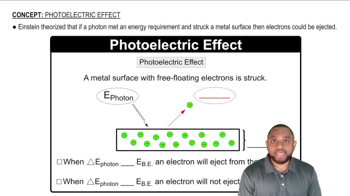
The photoelectric effect refers to the phenomenon where electrons are emitted from a material (usually a metal) when it is exposed to light of sufficient frequency. This effect demonstrates the particle nature of light, as photons must have enough energy to overcome the work function of the material to eject electrons.
Recommended video:
Guided course
02:31
Photoelectric Effect

Frequency and Wavelength Relationship

The frequency (ν) and wavelength (λ) of electromagnetic radiation are inversely related through the equation c = νλ, where c is the speed of light. This means that as the wavelength increases, the frequency decreases, and vice versa. Understanding this relationship is crucial for converting the given wavelength of light into frequency for calculations.
Recommended video:
Guided course
00:31
Frequency-Wavelength Relationship

Kinetic Energy of Ejected Electrons

The kinetic energy (KE) of ejected electrons in the photoelectric effect can be calculated using the equation KE = hν - φ, where h is Planck's constant, ν is the frequency of the incident light, and φ is the work function of the metal. This relationship highlights how the energy of the incoming photons is converted into the kinetic energy of the emitted electrons.
Recommended video:
Guided course
00:34
Kinetic & Potential Energy
Related Practice
Textbook Question

In August 2011, the Juno spacecraft was launched from Earth with the mission of orbiting Jupiter, arriving nearly five years later in July of 2016. The distance between the two planets varies depending on where each planet is in its orbit, but at the closest, the distance between Jupiter and Earth is 391 million miles. What is the minimum amount of time it takes for a transmitted signal from Juno to reach the Earth?

3
views
Textbook Question

The human retina has three types of receptor cones, each sensitive to a different range of wavelengths of visible light, as shown in this figure (the colors are merely to differentiate the three curves from one another; they do not indicate the actual colors represented by each curve):

(c) Explain why the sky appears blue even though all wavelengths of solar light are scattered by the atmosphere.

548
views
Textbook Question

Consider a transition in which the electron of a hydrogen atom is excited from n = 1 to n = ∞. (a) What is the end result of this transition?

764
views
Textbook Question

Consider a transition in which the electron of a hydrogen atom is excited from n = 1 to n = ∞. (b) What is the wavelength of light that must be absorbed to accomplish this process?

1090
views
Textbook Question

Certain elements emit light of a specific wavelength when they are burned or heated in a non-luminous flame. Historically, chemists used such emission wavelengths to determine whether specific elements were present in a sample. Some characteristic wavelengths for a few of the elements are given in the following table:

Ag 328.1 nm Fe 372.0 nm

Au 267.6 nm K 404.7 nm

Ba 455.4 nm Mg 285.2 nm

Ca 422.7 nm Na 589.6 nm

Cu 324.8 nm Ni 341.5 nm

(c) When burned, a sample of an unknown substance is found to emit light of frequency 6.58 * 1014 s-1. Which of these elements is probably in the sample?

3
views