Scientists have speculated that element 126 might have a moderate stability, allowing it to be synthesized and characterized. Predict what the condensed electron configuration of this element might be.
Ch.6 - Electronic Structure of Atoms

Brown15th EditionChemistry: The Central ScienceISBN: 9780137542970Not the one you use?Change textbook
Chapter 6, Problem 103
Microwave ovens use microwave radiation to heat food. The energy of the microwaves is absorbed by water molecules in food and then transferred to other components of the food. (a) Suppose that the microwave radiation has a wavelength of 10 cm. How many photons are required to heat 200 mL of water from 25 to 75 °C?
Verified step by step guidance1
Step 1: Calculate the energy required to heat the water. Use the formula for heat energy: \( q = m \cdot c \cdot \Delta T \), where \( m \) is the mass of the water, \( c \) is the specific heat capacity of water (4.18 J/g°C), and \( \Delta T \) is the change in temperature.
Step 2: Convert the volume of water to mass. Since the density of water is approximately 1 g/mL, 200 mL of water has a mass of 200 g.
Step 3: Calculate the change in temperature \( \Delta T \) as the final temperature minus the initial temperature: \( 75°C - 25°C = 50°C \).
Step 4: Calculate the energy of a single photon using the formula \( E = \frac{hc}{\lambda} \), where \( h \) is Planck's constant (6.626 \(\times\) 10^{-34} \(\text{ J s}\)), \( c \) is the speed of light (3.00 \(\times\) 10^8 \(\text{ m/s}\)), and \( \lambda \) is the wavelength of the microwave radiation (10 cm converted to meters).
Step 5: Determine the number of photons required by dividing the total energy calculated in Step 1 by the energy of a single photon calculated in Step 4.
Key Concepts
Here are the essential concepts you must grasp in order to answer the question correctly.
Photon Energy
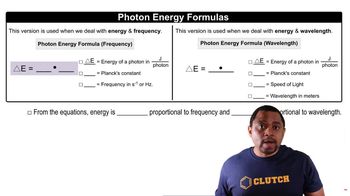
The energy of a photon is determined by its wavelength, described by the equation E = hc/λ, where E is energy, h is Planck's constant, c is the speed of light, and λ is the wavelength. For microwaves with a wavelength of 10 cm, this relationship allows us to calculate the energy of each photon, which is essential for determining how many photons are needed to heat the water.
Recommended video:
Guided course
Photon Energy Formulas
Specific Heat Capacity
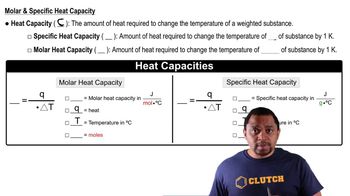
Specific heat capacity is the amount of heat required to raise the temperature of a unit mass of a substance by one degree Celsius. For water, this value is approximately 4.18 J/g°C. Understanding this concept is crucial for calculating the total energy needed to heat 200 mL of water from 25 to 75 °C, as it directly influences the total energy required for the temperature change.
Recommended video:
Guided course
Heat Capacity
Energy Transfer in Heating
When microwaves heat food, the energy absorbed by water molecules increases their kinetic energy, leading to a rise in temperature. This energy transfer is key to understanding how the absorbed energy from photons translates into thermal energy, allowing us to calculate the total number of photons needed based on the energy required to achieve the desired temperature increase in the water.
Recommended video:
Guided course
Heat Capacity
Related Practice
Textbook Question
1418
views
Textbook Question
In the experiment shown schematically below, a beam of neutral atoms is passed through a magnetic field. Atoms that have unpaired electrons are deflected in different directions in the magnetic field depending on the value of the electron spin quantum number. In the experiment illustrated, we envision that a beam of hydrogen atoms splits into two beams. (a) What is the significance of the observation that the single beam splits into two beams?
415
views
Textbook Question
Using the periodic table as a guide, write the condensed electron configuration and determine the number of unpaired electrons for the ground state of d. Sb
2
views