Ch.6 - Electronic Structure of Atoms
Brown - Chemistry: The Central Science 15th Edition
Brown15th EditionChemistry: The Central ScienceISBN: 9780137542970Not the one you use?Change textbook
Chapter 6, Problem 43a

One of the emission lines of the hydrogen atom has a wavelength of 93.07 nm. a. In what region of the electromagnetic spectrum is this emission found?

Verified step by step guidance
1
insert step 1> Convert the given wavelength from nanometers to meters by using the conversion factor: 1 nm = 1 x 10^{-9} m.
insert step 2> Recall the regions of the electromagnetic spectrum and their corresponding wavelength ranges.
insert step 3> Compare the converted wavelength to the known ranges of the electromagnetic spectrum to determine the region.
insert step 4> Identify the region of the electromagnetic spectrum that corresponds to the given wavelength.
insert step 5> Conclude which part of the electromagnetic spectrum the emission line belongs to based on the comparison.

Verified video answer for a similar problem:

This video solution was recommended by our tutors as helpful for the problem above.
Video duration:
38s
Was this helpful?

Key Concepts

Here are the essential concepts you must grasp in order to answer the question correctly.

Electromagnetic Spectrum

The electromagnetic spectrum encompasses all types of electromagnetic radiation, arranged by wavelength or frequency. It includes various regions such as radio waves, microwaves, infrared, visible light, ultraviolet, X-rays, and gamma rays. Each region has distinct properties and applications, with wavelengths ranging from kilometers for radio waves to picometers for gamma rays.

Wavelength and Frequency

Wavelength is the distance between successive peaks of a wave, typically measured in nanometers (nm) for light. Frequency, measured in hertz (Hz), indicates how many wave peaks pass a point in one second. The relationship between wavelength and frequency is inversely proportional, described by the equation c = λν, where c is the speed of light, λ is wavelength, and ν is frequency.
Recommended video:
Guided course
00:31
Frequency-Wavelength Relationship

Ultraviolet Radiation

Ultraviolet (UV) radiation is a type of electromagnetic radiation with wavelengths shorter than visible light, typically ranging from about 10 nm to 400 nm. The specific wavelength of 93.07 nm falls within the extreme ultraviolet (EUV) region, which is known for its high energy and ability to ionize atoms. UV radiation has various applications, including sterilization and phototherapy, but can also pose health risks.
Recommended video:
Guided course
02:52
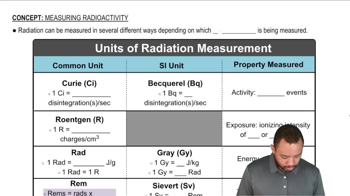
Units of Radiation Measurement
Related Practice
Textbook Question

Use the de Broglie relationship to determine the wavelengths of the following objects: (a) an 85-kg person skiing at 50 km/hr (b) a 10.0-g bullet fired at 250 m/s

695
views

Textbook Question

One of the emission lines of the hydrogen atom has a wavelength of 93.07 nm. b. Determine the initial and final values of n associated with this emission.

3
views
Textbook Question

The Lyman series of emission lines of the hydrogen atom are those for which nf = 1. (a) Determine the region of the electromagnetic spectrum in which the lines of the Lyman series are observed.

657
views
Textbook Question

The visible emission lines observed by Balmer all involved nf = 2. (b) Calculate the wavelengths of the first three lines in the Balmer series—those for which ni = 3, 4, and 5—and identify these lines in the emission spectrum shown in Figure 6.11.

1282
views
Textbook Question

The visible emission lines observed by Balmer all involved nf = 2. (a) Which of the following is the best explanation of why the lines with nf = 3 are not observed in the visible portion of the spectrum: (i) Transitions to nf = 3 are not allowed to happen, (ii) transitions to nf = 3 emit photons in the infrared portion of the spectrum, (iii) transitions to nf = 3 emit photons in the ultraviolet portion of the spectrum, or (iv) transitions to nf = 3 emit photons that are at exactly the same wavelengths as those to nf = 2.

1104
views
Textbook Question

Among the elementary subatomic particles of physics is the muon, which decays within a few microseconds after formation. The muon has a rest mass 206.8 times that of an electron. Calculate the de Broglie wavelength associated with a muon traveling at 8.85 * 105 cm/s.

640
views