Ch.8 - Basic Concepts of Chemical Bonding
Brown - Chemistry: The Central Science 15th Edition
Brown15th EditionChemistry: The Central ScienceISBN: 9780137542970Not the one you use?Change textbook
Chapter 8, Problem 63

Draw the dominant Lewis structures for these chlorine–oxygen molecules/ions: ClO, ClO-, ClO2-, ClO3-, ClO4-. Which of these do not obey the octet rule?

Verified step by step guidance
1
Step 1: Identify the total number of valence electrons for each molecule/ion. For chlorine (Cl), it has 7 valence electrons, and for oxygen (O), it has 6 valence electrons. Consider any additional electrons due to negative charges.
Step 2: For each molecule/ion, arrange the atoms with chlorine as the central atom and connect the oxygen atoms to chlorine using single bonds initially.
Step 3: Distribute the remaining valence electrons to satisfy the octet rule for the oxygen atoms first, then place any remaining electrons on the chlorine atom.
Step 4: If the central chlorine atom does not have a complete octet, consider forming double bonds with oxygen atoms by converting lone pairs on oxygen to bonding pairs.
Step 5: Evaluate each structure to determine if the octet rule is obeyed. Note that molecules/ions with an odd number of electrons or those with expanded octets (like ClO4-) may not strictly follow the octet rule.

Key Concepts

Here are the essential concepts you must grasp in order to answer the question correctly.

Lewis Structures

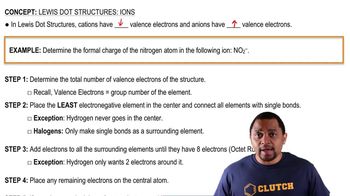
Lewis structures are diagrams that represent the bonding between atoms in a molecule and the lone pairs of electrons that may exist. They use dots to represent valence electrons and lines to represent bonds between atoms. Understanding how to draw Lewis structures is essential for visualizing molecular geometry and predicting the behavior of molecules.
Recommended video:
Guided course
04:28
Lewis Dot Structures: Ions

Octet Rule

The octet rule is a chemical rule of thumb that states atoms tend to bond in such a way that they each have eight electrons in their valence shell, achieving a stable electron configuration similar to that of noble gases. While this rule applies to many main-group elements, there are exceptions, particularly for elements in the third period and beyond, which can expand their octet.

Formal Charge

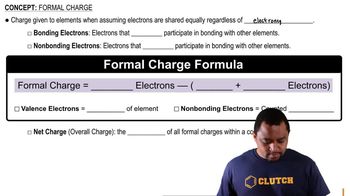
Formal charge is a concept used to determine the distribution of electrons in a molecule and to assess the stability of different Lewis structures. It is calculated by taking the number of valence electrons in an atom, subtracting the number of non-bonding electrons, and half the number of bonding electrons. Structures with the lowest formal charges on atoms are generally more stable and preferred.
Recommended video:
Guided course
01:53
Formal Charge
Related Practice
Textbook Question

In the vapor phase, BeCl2 exists as a discrete molecule. (a) Draw the Lewis structure of this molecule, using only single bonds. Does this Lewis structure satisfy the octet rule?

613
views

Textbook Question

Consider a Lewis structure for SO3 that satisfies the octet rule. Which of the following statements is or are true?

i. SO3 has three equivalent resonance structures.

ii. There are one shorter and two longer S—O bond lengths in SO3.

iii. The S atom in SO3 has a nonzero formal charge.

Textbook Question

(a) Describe the molecule xenon trioxide, XeO3, using four possible Lewis structures, one each with zero, one, two, or three Xe¬O double bonds. (b) Do any of these resonance structures satisfy the octet rule for every atom in the molecule? (c) Do any of the four Lewis structures have multiple resonance structures? If so, how many resonance structures do you find? (d) Which of the Lewis structures in part (a) yields the most favorable formal charges for the molecule?

1419
views
Textbook Question

Which of the following statements about benzene, C6H6, is or are true?

i. Benzene has two equivalent resonance structures.

ii. There are no nonbonding pairs in the Lewis structure for benzene.

iii. Benzene has three short and three long C—C bonds.

Textbook Question

b. Which of these compounds or ions is an exception to the octet rule: nitrogen dioxide, borohydride (BH4−), borazine (B3N3H6 which is analogous to benzene with alternating B and N in the ring), or boron trichloride?

2
views
Textbook Question

Draw the Lewis structures for each of the following molecules or ions. Identify instances where the octet rule is not obeyed; state which atom in each compound does not follow the octet rule; and state how many electrons surround these atoms: a. NO, b. BF3, c. ICl2, d. OPBr3 (the P is the central atom), e. XeF4.

3
views