
Ch.8 - Basic Concepts of Chemical Bonding
Brown - Chemistry: The Central Science 15th Edition
Brown15th EditionChemistry: The Central ScienceISBN: 9780137542970Not the one you use?Change textbook
Chapter 8, Problem 96b

Mothballs are composed of naphthalene, C10H8, a molecule that consists of two six-membered rings of carbon fused along an edge, as shown in this incomplete Lewis structure:
(b) Do you expect the C—C bond lengths in the molecule to be similar to those of C—C single bonds, C ═C double bonds, or intermediate between C—C single and C ═C double bonds?

Verified step by step guidance
1
Start by considering the structure of naphthalene, C_{10}H_{8}, which consists of two fused benzene rings.
Recall that benzene rings exhibit resonance, meaning the electrons are delocalized over the entire ring structure.
Understand that in benzene, the C—C bonds are not purely single or double bonds, but rather an intermediate bond length due to resonance.
Apply this concept to naphthalene, which also has delocalized electrons across its rings, leading to C—C bond lengths that are intermediate between single and double bonds.
Conclude that the C—C bond lengths in naphthalene are expected to be similar to those in benzene, which are intermediate between C—C single and C═C double bonds.

Verified video answer for a similar problem:

This video solution was recommended by our tutors as helpful for the problem above.
Video duration:
1m
Was this helpful?

Key Concepts

Here are the essential concepts you must grasp in order to answer the question correctly.

Bond Lengths and Types

In chemistry, bond lengths vary depending on the type of bond between atoms. C—C single bonds are longer than C═C double bonds due to the increased electron density and stronger attraction in double bonds, which pulls the atoms closer together. Understanding these differences is crucial for predicting molecular structure and behavior.
Recommended video:
Guided course
02:15
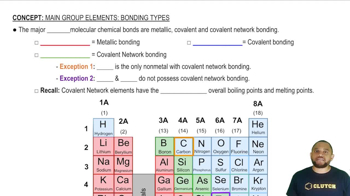
Bonding Types

Resonance Structures

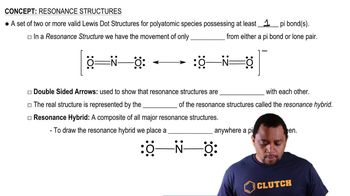
Molecules like naphthalene can exhibit resonance, where multiple valid Lewis structures can represent the same molecule. This delocalization of electrons can lead to bond lengths that are intermediate between single and double bonds, as the electrons are not localized to a single bond but are spread over multiple bonds.
Recommended video:
Guided course
01:42
Resonance Structures

Molecular Geometry and Hybridization

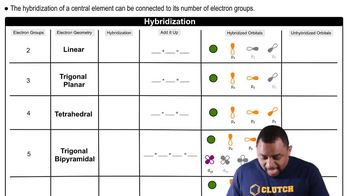
The geometry of a molecule and the hybridization of its atomic orbitals influence bond lengths and angles. In naphthalene, the carbon atoms are sp² hybridized, which affects the bond character and lengths. Understanding hybridization helps in predicting the molecular shape and the nature of the bonds present.
Recommended video:
Guided course
03:06
Hybridization and Electron Geometry
Related Practice
Textbook Question

Mothballs are composed of naphthalene, C10H8, a molecule that consists of two six-membered rings of carbon fused along an edge, as shown in this incomplete Lewis structure:(a) Draw all of the resonance structures of naphthalene. How many are there?

762
views
Textbook Question

The following three Lewis structures can be drawn for N2O:

(b) The N—N bond length in N2O is 1.12 Å, slightly longer than a typical N≡N bond; and the N—O bond length is 1.19 Å, slightly shorter than a typical N═O bond (see Table 8.4). Based on these data, which resonance structure best represents N2O?

1698
views
Textbook Question

Mothballs are composed of naphthalene, C10H8, a molecule that consists of two six-membered rings of carbon fused along an edge, as shown in this incomplete Lewis structure:

(c) Not all of the C—C bond lengths in naphthalene are equivalent. Based on your resonance structures, how many C—C bonds in the molecule do you expect to be shorter than the others?

978
views
Textbook Question

Ortho-Dichlorobenzene, C6H4Cl2, is obtained when two of the adjacent hydrogen atoms in benzene are replaced with Cl atoms. A skeleton of the molecule is shown here. (b) Are there any resonance structures for the molecule? If so, sketch them.

539
views
Textbook Question

Ortho-Dichlorobenzene, C6H4Cl2, is obtained when two of the adjacent hydrogen atoms in benzene are replaced with Cl atoms. A skeleton of the molecule is shown here. (a) Complete a Lewis structure for the molecule using bonds and electron pairs as needed.

480
views
Textbook Question

The following three Lewis structures can be drawn for N2O:

(a) Using formal charges, which of these three resonance forms is likely to be the most important?

1177
views