
The O—H bond lengths in the water molecule (H2O) are 0.96 Å, and the H—O—H angle is 104.5°. The overall dipole moment of the water molecule is 1.85 D. b. Calculate the magnitude of the bond dipole of the O─H bonds. (Note: You will need to use vector addition to do this.)

An AB5 molecule adopts the geometry shown here.
c. Suppose the B atoms are halogen atoms. Of which group in the periodic table is atom A a member:
i. group 5A
ii. group 6A
iii. group 7A
iv. group 8A, or
v. is more information needed?
Verified step by step guidance
Verified video answer for a similar problem:
Key Concepts
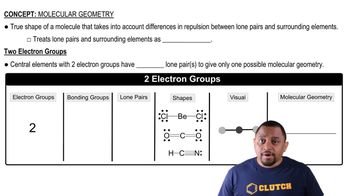
Molecular Geometry
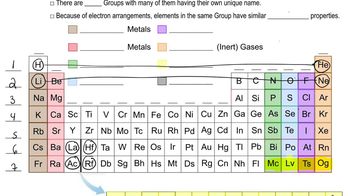
Periodic Table Groups
Halogens and Their Bonding
Fill in the blank spaces in the following chart. If the molecule column is blank, find an example that fulfills the conditions of the rest of the row. Molecule Electron-Domain Hybridization Dipole Geometry of Central Atom Moment? Yes or No CO2 sp3 Yes sp3 No Trigonal planar No SF4 Octahedral No sp2 Yes Trigonal bipyramidal No XeF2
The lactic acid molecule, CH3CH(OH)COOH, gives sour milk its unpleasant, sour taste. e. What are the approximate bond angles around each carbon atom in the molecule?
a. Predict the electron-domain geometry around the central Xe atom in XeF2, XeF4, and XeF6.
Which of the following statements about hybrid orbitals is or are true? a. After an atom undergoes sp hybridization, there is one unhybridized p orbital on the atom, b. Under 𝑠𝑝2 hybridization, the large lobes point to the vertices of an equilateral triangle, and c. The angle between the large lobes of 𝑠𝑝3 hybrids is 109.5°.
