Ch.9 - Molecular Geometry and Bonding Theories
Brown - Chemistry: The Central Science 15th Edition
Brown15th EditionChemistry: The Central ScienceISBN: 9780137542970Not the one you use?Change textbook
Chapter 9, Problem 82c2

(c) With what neutral homonuclear diatomic molecules are the NO+ and NO- ions isoelectronic (same number of electrons)? With what neutral homonuclear diatomic molecule is the NO- ion isoelectronic (same number of electrons)?

Verified step by step guidance
1
Determine the number of electrons in a neutral NO molecule. Nitrogen (N) has 7 electrons and Oxygen (O) has 8 electrons, so NO has a total of 15 electrons.
For the NO+ ion, subtract one electron from the total number of electrons in the neutral NO molecule, as the plus sign indicates a loss of one electron.
For the NO- ion, add one electron to the total number of electrons in the neutral NO molecule, as the minus sign indicates a gain of one electron.
Identify neutral homonuclear diatomic molecules that have the same number of electrons as calculated for NO+ and NO-. Homonuclear means the molecule is composed of two atoms of the same element.
Compare the electron counts to those of common homonuclear diatomic molecules like H2, N2, O2, F2, etc., to find the ones that are isoelectronic with NO+ and NO-.

Verified video answer for a similar problem:

This video solution was recommended by our tutors as helpful for the problem above.
Video duration:
1m
Was this helpful?

Key Concepts

Here are the essential concepts you must grasp in order to answer the question correctly.

Isoelectronic Species

Isoelectronic species are atoms, ions, or molecules that have the same number of electrons. This concept is crucial for comparing the electronic configurations of different species, as it helps identify similarities in their chemical behavior and properties. For example, the NO+ ion has one less electron than the neutral NO molecule, while the NO- ion has one more, allowing us to find neutral molecules that match their electron counts.
Recommended video:
Guided course
03:03
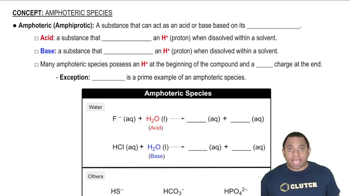
Amphoteric Species

Homonuclear Diatomic Molecules

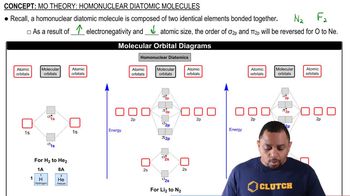
Homonuclear diatomic molecules consist of two identical atoms bonded together, such as O2 or N2. These molecules are significant in understanding molecular bonding and electronic structure, as they provide a basis for comparing the electron configurations of ions like NO+ and NO-. Identifying homonuclear diatomic molecules that are isoelectronic with these ions requires knowledge of their electron counts.
Recommended video:
Guided course
03:10
Homonuclear Diatomic Molecules

Electron Configuration

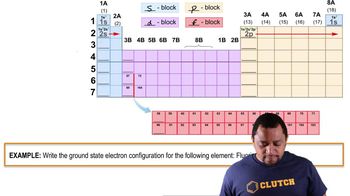
Electron configuration describes the distribution of electrons in an atom or ion's orbitals. It is essential for determining the number of electrons in a species and understanding its chemical properties. For the NO+ and NO- ions, knowing their electron configurations allows us to identify which neutral homonuclear diatomic molecules have the same number of electrons, facilitating the comparison needed to answer the question.
Recommended video:
Guided course
01:33
Electron Configuration Example
Related Practice
Textbook Question

Determine the electron configurations for CN+, CN, and CN-. (a) Which species has the strongest C¬N bond?

1822
views

Textbook Question

If we assume that the energy-level diagrams for homonuclear diatomic molecules shown in Figure 9.43 can be applied to heteronuclear diatomic molecules and ions, predict the bond order and magnetic behavior of b. NO–

2
views
Textbook Question

The iodine bromide molecule, IBr, is an interhalogen compound. Assume that the molecular orbitals of IBr are analogous to the homonuclear diatomic molecule F2. (c) One of the valence MOs of IBr is sketched here. Determine whether each of the following statements about this orbital is true: i. This is an antibonding orbital. ii. The larger contribution is from the I atom. iii. The energy of the molecular orbital is closer in energy to the valence atomic orbitals of Br than to those of I.

4
views
1
rank
Textbook Question

Assume that the MOs of diatomics from the third row of the periodic table, such as P2, are analogous to those from the second row.

a. Which valence atomic orbitals of P are used to construct the MOs of P2?

4
views
Textbook Question

If we assume that the energy-level diagrams for homonuclear diatomic molecules shown in Figure 9.43 can be applied to heteronuclear diatomic molecules and ions, predict the bond order and magnetic behavior of d. NeF+

2
views
Textbook Question

The iodine bromide molecule, IBr, is an interhalogen compound. Assume that the molecular orbitals of IBr are analogous to the homonuclear diatomic molecule F2. (a) Which valence atomic orbitals of I and of Br are used to construct the MOs of IBr?

843
views