For each statement, indicate whether it is true or false. (d) Nonbonding electron pairs cannot occupy a hybrid orbital.
Ch.9 - Molecular Geometry and Bonding Theories

Brown15th EditionChemistry: The Central ScienceISBN: 9780137542970Not the one you use?Change textbook
Chapter 9, Problem 46a
Draw sketches illustrating the overlap between the following orbitals on two atoms: (a) the 2s orbital on each atom
Verified step by step guidance1
Understand that the 2s orbital is spherical in shape and surrounds the nucleus of an atom.
Visualize two atoms, each with a 2s orbital, approaching each other.
Sketch two overlapping spheres to represent the 2s orbitals from each atom as they come into contact.
Label each sphere as '2s' to indicate the type of orbital involved in the overlap.
Note that the overlap of these orbitals can lead to the formation of a sigma bond if the atoms are close enough.

Verified video answer for a similar problem:
This video solution was recommended by our tutors as helpful for the problem above.
Video duration:
1mWas this helpful?
Key Concepts
Here are the essential concepts you must grasp in order to answer the question correctly.
Atomic Orbitals
Atomic orbitals are regions in an atom where there is a high probability of finding electrons. They are defined by quantum numbers and come in various shapes, such as s, p, d, and f. The 2s orbital, for example, is spherical and can hold up to two electrons. Understanding the shape and orientation of these orbitals is crucial for visualizing how they interact during bonding.
Orbital Overlap
Orbital overlap occurs when atomic orbitals from two atoms come into proximity, allowing their electron clouds to interact. This overlap is fundamental to the formation of covalent bonds, as it enables the sharing of electrons between atoms. The extent and type of overlap can influence the strength and characteristics of the bond formed, making it essential to understand in molecular chemistry.
Recommended video:
Guided course
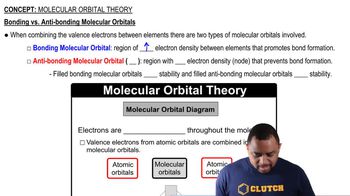
Molecular Orbital Theory
Covalent Bonding
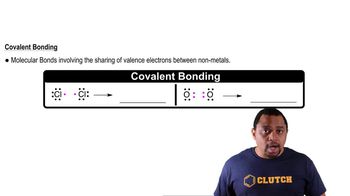
Covalent bonding is a type of chemical bond formed when two atoms share one or more pairs of electrons. This sharing typically occurs between nonmetals and is a key concept in understanding molecular structure and reactivity. The nature of the bond, including its strength and length, is influenced by the degree of overlap between the involved orbitals, such as the 2s orbitals in this case.
Recommended video:
Guided course
Chemical Bonds
Related Practice
Textbook Question
520
views
Textbook Question
Predict whether each of the following molecules is polar or nonpolar: (a) IF, (b) CS2, (c) SO3, (d) PCl3, (e) SF6, (f) IF5.
1680
views
Textbook Question
Consider the molecule BF3. (c) What hybrid orbitals should be constructed on the B atom to make the B–F bonds in BF3?
987
views
Textbook Question
Dichloroethylene (C2H2Cl2) has three forms (isomers), each of which is a different substance. (b) Which of these isomers has a zero dipole moment?
591
views
Textbook Question
Draw sketches illustrating the overlap between the following orbitals on two atoms: (b) the 2pz orbital on each atom (assume both atoms are on the z-axis) (c) the 2s orbital on one atom and the 2pz orbital on the other atom.
928
views
Textbook Question
Predict whether each of the following molecules is polar or nonpolar: (a) CCl4, (b) NH3, (c) SF4, (d) XeF4, (e) CH3Br, (f) GaH3.
1060
views