Perform each unit conversion. a. 28.9 nm to mm b. 1432 cm3 to L c. 1211 Tm to Gm

Ch.1 - Matter, Measurement & Problem Solving
Chapter 1, Problem 88a,b
Calculate to the correct number of significant figures. a. [(1.7×10⁶) / (2.63×10⁵)] + 7.33 b. (568.99 - 232.1) / 5.3
Verified step by step guidance1
Identify the operations involved: multiplication and addition.
Perform the multiplication: \((1.7 \times 10^6) \times (2.63 \times 10^5)\).
Determine the number of significant figures for the multiplication result. The number with the fewest significant figures is 1.7 (2 significant figures).
Add the result of the multiplication to 7.33. Ensure the addition is done with the correct number of decimal places based on the least precise measurement.
Express the final result with the correct number of significant figures, considering both the multiplication and addition steps.

Verified video answer for a similar problem:
This video solution was recommended by our tutors as helpful for the problem above.
Video duration:
1mWas this helpful?
Key Concepts
Here are the essential concepts you must grasp in order to answer the question correctly.
Significant Figures
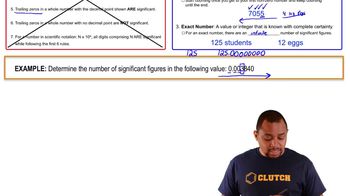
Significant figures are the digits in a number that contribute to its precision. This includes all non-zero digits, any zeros between significant digits, and trailing zeros in the decimal portion. Understanding significant figures is crucial for accurately reporting measurements and calculations in chemistry, as it reflects the precision of the data used.
Recommended video:
Guided course
Significant Figures Example
Scientific Notation
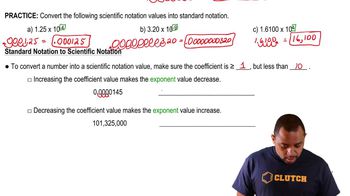
Scientific notation is a way of expressing numbers that are too large or too small to be conveniently written in decimal form. It is represented as a product of a number between 1 and 10 and a power of ten. This notation simplifies calculations, especially when dealing with very large or small quantities, which is common in chemistry.
Recommended video:
Guided course
Standard Notation to Scientific Notation
Order of Operations in Calculations
The order of operations is a set of rules that dictates the sequence in which calculations should be performed to ensure accurate results. In chemistry, this typically follows the PEMDAS/BODMAS rule (Parentheses, Exponents, Multiplication and Division, Addition and Subtraction). Correctly applying this order is essential when performing calculations involving addition, especially when combining numbers in scientific notation.
Recommended video:
Guided course
Bond Order Calculation
Related Practice
Textbook Question
Textbook Question
A flask containing 11.7 mL of a liquid weighs 132.8 g with the liquid in the flask and 124.1 g when empty. Calculate the density of the liquid in g/mL to the correct number of significant digits.
2246
views
Textbook Question
Calculate to the correct number of significant figures. d. (3.14 × 2.4367) - 2.34
889
views
Textbook Question
Calculate to the correct number of significant figures. a. 0.004 + 0.09879 b. 1239.3 + 9.73 + 3.42 c. 2.4 - 1.777
579
views
Textbook Question
Calculate to the correct number of significant figures. a. 0.004 + 0.09879 b. 1239.3 + 9.73 + 3.42 c. 2.4 - 1.777 d. 532 + 7.3 - 48.523
Textbook Question
Calculate to the correct number of significant figures. a. (24.6681 * 2.38) + 332.58 b. (85.3 - 21.489) , 0.0059 c. (512 , 986.7) + 5.44 d. [(28.7 * 105) , 48.533] + 144.99