
Read each measurement to the correct number of significant figures. Laboratory glassware should always be read from the bottom of the meniscus. Digital balances normally display mass to the correct number of significant figures for that particular balance.
Ch.1 - Matter, Measurement & Problem Solving
Chapter 1, Problem 75
For each number, underline the zeroes that are significant and draw an x through the zeroes that are not. a. 1,050,501 km b. 0.0020 m c. 0.000000000000002 s d. 0.001090 cm
Verified step by step guidance1
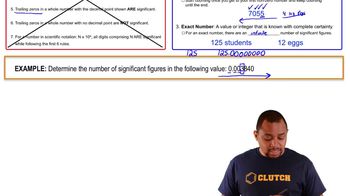
Identify significant figures: Significant figures are the digits in a number that contribute to its precision. This includes all non-zero digits, any zeroes between significant digits, and any trailing zeroes in the decimal portion.
For 1,050,501 km: The zero between 5 and 5 is significant because it is between two non-zero digits. The zeroes at the end are not significant because they are not followed by a decimal point.
For 0.0020 m: The zeroes before the 2 are not significant as they are only placeholders. The zero after the 2 is significant because it is a trailing zero in the decimal portion.
For 0.000000000000002 s: All zeroes before the 2 are not significant as they are only placeholders.
For 0.001090 cm: The zeroes before the 1 are not significant as they are only placeholders. The zero between 1 and 9 is significant because it is between two non-zero digits. The zero at the end is significant because it is a trailing zero in the decimal portion.

Verified video answer for a similar problem:
This video solution was recommended by our tutors as helpful for the problem above.
Video duration:
47sWas this helpful?
Key Concepts
Here are the essential concepts you must grasp in order to answer the question correctly.
Significant Figures
Significant figures are the digits in a number that contribute to its precision. This includes all non-zero digits, any zeros between significant digits, and trailing zeros in a decimal number. Understanding significant figures is crucial for accurately reporting measurements and calculations in scientific contexts.
Recommended video:
Guided course
Significant Figures Example
Leading Zeros
Leading zeros are the zeros that precede all non-zero digits in a number. They are not considered significant because they do not affect the value of the number. For example, in the number 0.0020, the leading zeros before the '2' are not significant, while the '2' and the trailing zero are.
Trailing Zeros
Trailing zeros are the zeros that follow non-zero digits in a number. Their significance depends on the presence of a decimal point. In a decimal number, trailing zeros are significant, as they indicate precision, while in whole numbers without a decimal, they may not be significant. For instance, in 1,050,501, all zeros are significant, but in 1000, the zeros may not be unless specified.
Related Practice
Textbook Question
664
views
1
comments
Textbook Question
Read each measurement to the correct number of significant figures. Laboratory glassware should always be read from the bottom of the meniscus. Digital balances normally display mass to the correct number of significant figures for that particular balance.
897
views
1
comments
Textbook Question
Read each measurement to the correct number of significant figures. Laboratory glassware should always be read from the bottom of the meniscus.
Textbook Question
How many significant figures are in each number? a. 0.000312 m b. 312,000 s c. 3.12 × 10⁵ km d. 13,127 s e. 2000
Textbook Question
For each number, underline the zeroes that are significant and draw an x through the zeroes that are not. a. 180,701 mi b. 0.001040 m c. 0.005710 km d. 90,201 m
Textbook Question
How many significant figures are in each number? d. 1.563300×10¹¹ m
757
views
