
Mercury is often used in thermometers. The mercury sits in a bulb on the bottom of the thermometer and rises up a thin capillary as the temperature rises. Suppose a mercury thermometer contains 3.380 g of mercury and has a capillary that is 0.200 mm in diameter. How far does the mercury rise in the capillary when the temperature changes from 0.0 °C to 25.0 °C? The density of mercury at these temperatures is 13.596 g/cm3 and 13.534 g/cm3, respectively
Ch.1 - Matter, Measurement & Problem Solving
Chapter 1, Problem 132
Rolls of aluminum foil are 304 mm wide and 0.016 mm thick. What maximum length of aluminum foil can be made from 1.10 kg of aluminum?
Verified step by step guidance1
Step 1: First, we need to find the volume of the aluminum foil. The volume of a substance can be calculated using the formula: Volume = Mass / Density. The density of aluminum is 2.70 g/cm³. Convert the mass of aluminum from kg to g for consistency in units.
Step 2: After finding the volume, we need to convert it from cm³ to mm³ because the dimensions of the foil are given in mm. The conversion factor is 1 cm³ = 1000 mm³.
Step 3: Now, we can calculate the length of the aluminum foil. The volume of a rectangular prism (which the roll of aluminum foil can be approximated to) is given by the formula: Volume = Length x Width x Height. In this case, the width and height are the width and thickness of the foil, respectively, and the length is what we're trying to find. So, rearrange the formula to solve for length: Length = Volume / (Width x Height).
Step 4: Substitute the values of volume, width, and height into the formula to find the length. Remember to keep the units consistent - they should all be in mm.
Step 5: The result will be the maximum length of aluminum foil that can be made from 1.10 kg of aluminum, in mm. If necessary, convert this to a more convenient unit (like m or cm).

Verified video answer for a similar problem:
This video solution was recommended by our tutors as helpful for the problem above.
Video duration:
7mWas this helpful?
Key Concepts
Here are the essential concepts you must grasp in order to answer the question correctly.
Density and Mass-Volume Relationship
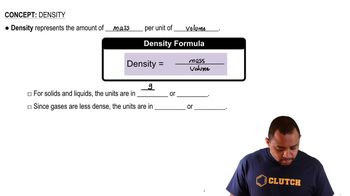
Density is defined as mass per unit volume and is a critical concept in determining how much material can be produced from a given mass. For aluminum, the density is approximately 2.70 g/cm³. By using the mass of aluminum (1.10 kg) and its density, we can calculate the volume of aluminum available for making foil.
Recommended video:
Guided course
Density Concepts
Volume of a Rectangular Prism
The volume of a rectangular prism, such as a roll of aluminum foil, can be calculated using the formula V = length × width × thickness. In this case, the width and thickness of the foil are given, allowing us to express the maximum length of foil that can be produced in terms of the total volume derived from the mass of aluminum.
Recommended video:
Guided course
Constant-Volume Calorimetry
Unit Conversion
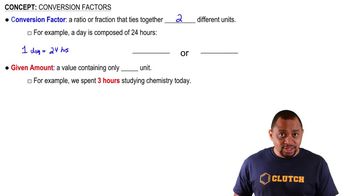
Unit conversion is essential in chemistry to ensure that all measurements are in compatible units. In this problem, we need to convert the mass of aluminum from kilograms to grams (1.10 kg = 1100 g) and the dimensions of the foil from millimeters to centimeters for consistency with the density units. This step is crucial for accurate calculations.
Recommended video:
Guided course
Conversion Factors
Related Practice
Textbook Question
1929
views
1
rank
Textbook Question
Lead metal can be extracted from a mineral called galena, which contains 86.6% lead by mass. A particular ore contains 68.5% galena by mass. If the lead can be extracted with 92.5% efficiency, what mass of ore is required to make a lead sphere with a 5.00-cm radius?
1468
views
1
comments
Textbook Question
The daily recommended intake of calcium for an average adult is 1,000 mg. There is 125 mg of calcium in 100 grams of milk. If a 150 g smoothie contains 75 grams of milk, how many grams of smoothie should an adult consume to meet the daily recommended intake?
2101
views
2
comments
Textbook Question
A length of #8 copper wire (radius = 1.63 mm) has a mass of 24.0 kg and a resistance of 2.061 ohm per km (Ω / km). What is the overall resistance of the wire?
880
views
1
rank
