Textbook Question
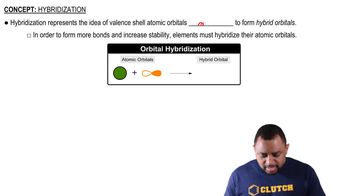
Write orbital diagrams (boxes with arrows in them) to represent the electron configurations of carbon before and after sp hybridization.
1052
views

 Tro 4th EditionCh.10 - Chemical Bonding II: Molecular Shapes & Valence Bond TheoryProblem 61a
 Verified step by step guidance
 00:51
00:51
 01:33
01:33 03:06
03:06Write orbital diagrams (boxes with arrows in them) to represent the electron configurations of carbon before and after sp hybridization.
Write a hybridization and bonding scheme for each molecule. Sketch the molecule, including overlapping orbitals, and label all bonds using the notation shown in Examples 10.6 and 10.7.a. CH2Br2 b. SO2 c. NF3 d. BF3
Write a hybridization and bonding scheme for each molecule. Sketch the molecule, including overlapping orbitals, and label all bonds using the notation shown in Examples 10.6 and 10.7. b. NH3
Which hybridization scheme allows the central atom to form more than four bonds? sp3, sp3d, sp2
Write a hybridization and bonding scheme for each molecule. Sketch the molecule, including overlapping orbitals, and label all bonds using the notation shown in Examples 10.6 and 10.7. c. OF2 d. CO2
Write orbital diagrams (boxes with arrows in them) to represent the electron configurations—without hybridization—for all the atoms in SF2. Circle the electrons involved in bonding. Draw a three-dimensional sketch of the molecule and show orbital overlap. What bond angle do you expect from the unhybridized orbitals? How well does valence bond theory agree with the experimentally measured bond angle of 98.2° ?