

Ch.10 - Chemical Bonding II: Molecular Shapes & Valence Bond Theory
Tro - Chemistry: A Molecular Approach 4th Edition
Tro4th EditionChemistry: A Molecular ApproachISBN: 9780134112831Not the one you use?Change textbook
Chapter 10, Problem 71

Draw an MO energy diagram and predict the bond order of Be2+ and Be2- . Do you expect these molecules to exist in the gas phase?

Verified step by step guidance
1
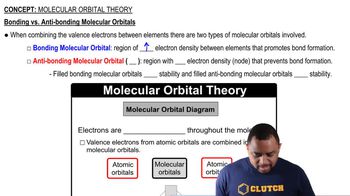
Start by understanding the molecular orbital (MO) theory, which describes the distribution of electrons in molecules. For diatomic molecules like Be2, we consider the combination of atomic orbitals from each Be atom to form molecular orbitals.
Identify the atomic orbitals involved: Beryllium (Be) has the electron configuration 1s^2 2s^2. For Be2, we will consider the 2s orbitals from each Be atom combining to form molecular orbitals.
Construct the MO energy diagram for Be2: The 2s orbitals combine to form a bonding molecular orbital (σ2s) and an antibonding molecular orbital (σ*2s). For Be2+, remove one electron from the highest energy orbital, and for Be2-, add one electron to the highest energy orbital.
Calculate the bond order using the formula: Bond Order = (Number of electrons in bonding MOs - Number of electrons in antibonding MOs) / 2. Apply this formula to both Be2+ and Be2- to determine their bond orders.
Evaluate the stability of Be2+ and Be2- based on their bond orders. A positive bond order suggests the possibility of the molecule existing in the gas phase, while a bond order of zero or negative indicates instability.

Verified video answer for a similar problem:

This video solution was recommended by our tutors as helpful for the problem above.
Was this helpful?

Key Concepts

Here are the essential concepts you must grasp in order to answer the question correctly.

Molecular Orbital Theory

Molecular Orbital (MO) Theory describes the behavior of electrons in molecules, where atomic orbitals combine to form molecular orbitals that can be occupied by electrons. These orbitals are categorized as bonding, antibonding, or non-bonding, influencing the stability and properties of the molecule. Understanding MO diagrams is essential for predicting bond order and molecular stability.
Recommended video:
Guided course
03:06
Molecular Orbital Theory

Bond Order

Bond order is a measure of the number of chemical bonds between a pair of atoms, calculated as the difference between the number of bonding and antibonding electrons divided by two. A higher bond order indicates a stronger and more stable bond. For diatomic molecules, bond order helps predict their existence and stability in the gas phase.
Recommended video:
Guided course
00:36
Average Bond Order

Stability of Ions

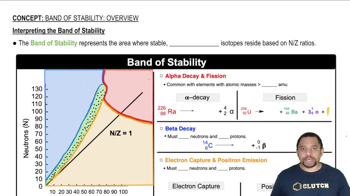
The stability of ions like Be2+ and Be2- is influenced by their electronic configurations and the resulting bond orders. Be2+ has lost an electron, potentially leading to a higher bond order and greater stability, while Be2- has gained an electron, which may result in a lower bond order and less stability. Understanding these factors helps predict whether these ions can exist in the gas phase.
Recommended video:
Guided course
03:13
Intepreting the Band of Stability
Related Practice
Textbook Question

Using the molecular orbital energy ordering for second-row homonuclear diatomic molecules in which the π2p orbitals lie at lower energy than the σ2p, draw MO energy diagrams and predict the bond order in a molecule or ion with each number of total valence electrons. Will the molecule or ion be diamagnetic or paramagnetic? a. 4 b. 6

332
views
Textbook Question

Sketch the bonding molecular orbital that results from the linear combination of two 1s orbitals. Indicate the region where interference occurs and state the kind of interference (constructive or destructive).

1214
views
Textbook Question

Sketch the bonding and antibonding molecular orbitals that result from linear combinations of the 2pz atomic orbitals in a homonuclear diatomic molecule. (The 2pz orbitals are those whose lobes are oriented perpendicular to the bonding axis.) How do these molecular orbitals differ from those obtained from linear combinations of the 2py atomic orbitals? (The 2py orbitals are also oriented perpendicular to the bonding axis, but also perpendicular to the 2pz orbitals.)

817
views
Textbook Question

Consider the structure of the amino acid aspartic acid. Indicate the hybridization about each interior atom.

1328
views
Textbook Question

Draw an MO energy diagram and predict the bond order of Li2+ and Li2-. Do you expect these molecules to exist in the gas phase?

2618
views
Textbook Question

Write a hybridization and bonding scheme for each molecule that contains more than one interior atom. Indicate the hybridization about each interior atom. Sketch the structure, including overlapping orbitals, and label all bonds using the notation shown in Examples 10.6 and 10.7. c. C2H6 (skeletal structure H3CCH3)

1291
views