The vapor pressure of CCl3F at 300 K is 856 torr. If 11.5 g of CCl3F is enclosed in a 1.0-L container, will any liquid be present? If so, what mass of liquid?
Ch.11 - Liquids, Solids & Intermolecular Forces
Chapter 11, Problem 90
A sample of steam with a mass of 0.552 g and at a temperature of 100 °C condenses into an insulated container holding 4.25 g of water at 5.0 °C. Assuming that no heat is lost to the surroundings, what is the final temperature of the mixture?
Verified step by step guidance1
Identify the process: The steam will first condense into water at 100 °C, releasing heat, and then the resulting water will cool down to reach thermal equilibrium with the water initially in the container.
Calculate the heat released during the condensation of steam using the formula: \( q_\text{condensation} = m_\text{steam} \times \Delta H_\text{vap} \), where \( \Delta H_\text{vap} \) is the heat of vaporization of water.
Calculate the heat lost by the condensed steam as it cools from 100 °C to the final temperature \( T_f \) using: \( q_\text{cooling} = m_\text{condensed water} \times c_\text{water} \times (T_f - 100) \), where \( c_\text{water} \) is the specific heat capacity of water.
Calculate the heat gained by the initial water in the container as it warms from 5.0 °C to \( T_f \) using: \( q_\text{warming} = m_\text{initial water} \times c_\text{water} \times (T_f - 5) \).
Set the total heat lost by the steam equal to the total heat gained by the initial water and solve for the final temperature \( T_f \).

Verified video answer for a similar problem:
This video solution was recommended by our tutors as helpful for the problem above.
Video duration:
7mWas this helpful?
Key Concepts
Here are the essential concepts you must grasp in order to answer the question correctly.
Heat Transfer and Conservation of Energy
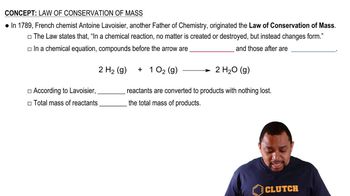
In thermodynamics, the principle of conservation of energy states that energy cannot be created or destroyed, only transformed. In this scenario, the heat lost by the steam as it condenses and cools must equal the heat gained by the water as it warms up. This relationship allows us to set up an equation to solve for the final temperature of the mixture.
Recommended video:
Guided course
Law of Conservation of Mass
Specific Heat Capacity
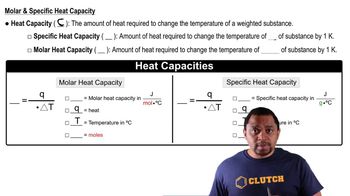
Specific heat capacity is the amount of heat required to raise the temperature of a unit mass of a substance by one degree Celsius. Different substances have different specific heat capacities, which affect how they respond to heat transfer. In this problem, the specific heat capacities of steam and water will be crucial for calculating the heat exchange during the condensation and warming processes.
Recommended video:
Guided course
Heat Capacity
Phase Change and Latent Heat
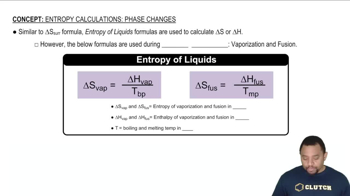
Phase changes, such as the condensation of steam into water, involve latent heat, which is the heat absorbed or released during a phase transition without a change in temperature. The latent heat of vaporization for water is significant in this problem, as it quantifies the energy released when steam condenses. Understanding this concept is essential for accurately calculating the heat transfer involved in the process.
Recommended video:
Guided course
Entropy in Phase Changes
Related Practice
Textbook Question
991
views
Textbook Question
Air conditioners not only cool air, but dry it as well. A room in a home measures 6.0 m × 10.0 m × 2.2 m. If the outdoor temperature is 30 °C and the partial pressure of water in the air is 85% of the vapor pressure of water at this temperature, what mass of water must be removed from the air each time the volume of air in the room is cycled through the air conditioner? (Assume that all of the water must be removed from the air.) The vapor pressure for water at 30 °C is 31.8 torr.
997
views
3
rank
Textbook Question
Explain the observed trend in the boiling points of these compounds.
H2Te -2 °C
H2Se -41.5 °C
H2S -60.7 °C
H2O 100 °C
2644
views