An 8.5-g ice cube is placed into 255 g of water. Calculate the temperature change in the water upon the complete melting of the ice. Assume that all of the energy required to melt the ice comes from the water.
Ch.11 - Liquids, Solids & Intermolecular Forces
Chapter 11, Problem 64
Benzene has a heat of vaporization of 30.72 kJ/mol and a normal boiling point of 80.1 °C. At what temperature does benzene boil when the external pressure is 445 torr?
Verified step by step guidance1
Identify the known values: the heat of vaporization (\(\Delta H_{vap} = 30.72 \text{ kJ/mol}\)), the normal boiling point (\(T_1 = 80.1 \degree C\)), and the normal pressure (\(P_1 = 760 \text{ torr}\)).
Convert the normal boiling point from Celsius to Kelvin: \(T_1 = 80.1 + 273.15\).
Use the Clausius-Clapeyron equation: \(\ln\left(\frac{P_2}{P_1}\right) = -\frac{\Delta H_{vap}}{R} \left(\frac{1}{T_2} - \frac{1}{T_1}\right)\), where \(P_2 = 445 \text{ torr}\) and \(R = 8.314 \text{ J/mol K}\).
Rearrange the Clausius-Clapeyron equation to solve for \(T_2\): \(T_2 = \left(\frac{1}{T_1} - \frac{R}{\Delta H_{vap}} \ln\left(\frac{P_2}{P_1}\right)\right)^{-1}\).
Substitute the known values into the equation and solve for \(T_2\) in Kelvin, then convert back to Celsius if needed.

Verified video answer for a similar problem:
This video solution was recommended by our tutors as helpful for the problem above.
Video duration:
7mWas this helpful?
Key Concepts
Here are the essential concepts you must grasp in order to answer the question correctly.
Heat of Vaporization
The heat of vaporization is the amount of energy required to convert a unit mass of a liquid into vapor without a change in temperature. For benzene, this value is 30.72 kJ/mol, indicating the energy needed to vaporize one mole of benzene at its boiling point under standard atmospheric pressure.
Recommended video:
Guided course
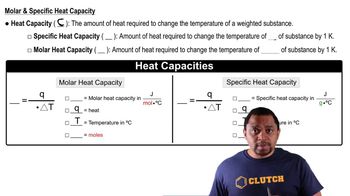
Heat Capacity
Boiling Point and External Pressure
The boiling point of a liquid is the temperature at which its vapor pressure equals the external pressure surrounding it. As external pressure increases, the boiling point of the liquid also increases. In this case, the boiling point of benzene will change when the external pressure is adjusted to 445 torr, which is lower than standard atmospheric pressure.
Recommended video:
Guided course
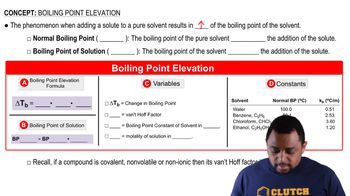
Boiling Point Elevation
Clausius-Clapeyron Equation
The Clausius-Clapeyron equation relates the change in vapor pressure with temperature to the heat of vaporization. It can be used to calculate the new boiling point of a substance when the external pressure changes. This equation is essential for determining how the boiling point of benzene will shift from its normal boiling point of 80.1 °C at a pressure of 445 torr.
Recommended video:
Guided course
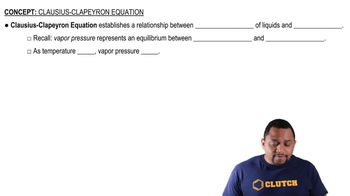
Clausius-Clapeyron Equation
Related Practice
Textbook Question
3326
views
Textbook Question
Carbon disulfide has a vapor pressure of 363 torr at 25 °C and a normal boiling point of 46.3 °C. Find ΔHvap for carbon disulfide.
2567
views
Textbook Question
How much energy is released when 65.8 g of water freezes?
1819
views
2
rank
Textbook Question
This table displays the vapor pressure of ammonia at several different temperatures. Use the data to determine the heat of vaporization and normal boiling point of ammonia.
Temperature (K) Pressure (torr)
200 65.3
210 134.3
220 255.7
230 456.0
235 597.0
2529
views
1
comments
Textbook Question
Ethanol has a heat of vaporization of 38.56 kJ/mol and a normal boiling point of 78.4 °C. What is the vapor pressure of ethanol at 15 °C?
5630
views
1
comments