
Nitrogen has a normal boiling point of 77.3 K and a melting point (at 1 atm) of 63.1 K. Its critical temperature is 126.2 K and its critical pressure is 2.55×10⁴ torr. It has a triple point at 63.1 K and 94.0 torr. Sketch the phase diagram for nitrogen. Does nitrogen have a stable liquid state at 1 atm?
Ch.11 - Liquids, Solids & Intermolecular Forces
Chapter 11, Problem 81
Explain the role of water in moderating Earth's climate.
Verified step by step guidance1
Water has a high specific heat capacity, which means it can absorb and store large amounts of heat energy with only a small change in temperature. This property helps to stabilize the Earth's climate by moderating temperature fluctuations.
The oceans act as a heat reservoir, absorbing heat during the day and releasing it slowly at night, which helps to keep coastal regions warmer in winter and cooler in summer compared to inland areas.
Water vapor in the atmosphere is a greenhouse gas, which traps heat and helps to maintain the Earth's temperature by preventing heat from escaping into space.
The process of evaporation and condensation of water helps to distribute heat around the planet. When water evaporates, it absorbs heat, and when it condenses, it releases heat, which helps to regulate temperature.
Ocean currents, driven by the movement of water, play a crucial role in distributing heat around the globe, influencing weather patterns and climate by transferring warm water from the equator towards the poles and cold water from the poles towards the equator.
Key Concepts
Here are the essential concepts you must grasp in order to answer the question correctly.
Specific Heat Capacity
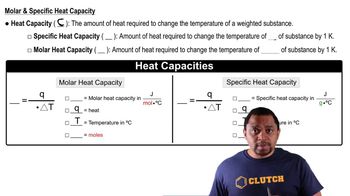
Specific heat capacity is the amount of heat required to raise the temperature of a unit mass of a substance by one degree Celsius. Water has a high specific heat capacity, which means it can absorb and store large amounts of heat without a significant change in temperature. This property allows oceans and large bodies of water to moderate temperature fluctuations, contributing to a more stable climate.
Recommended video:
Guided course
Heat Capacity
Evaporation and Condensation
Evaporation is the process by which water changes from a liquid to a gas, while condensation is the reverse process. These phase changes are crucial in the water cycle and play a significant role in climate regulation. When water evaporates, it absorbs heat from the environment, cooling the surface, and when it condenses, it releases heat, warming the atmosphere, thus influencing weather patterns and climate.
Ocean Currents
Ocean currents are large-scale flows of seawater that distribute heat across the planet. They are driven by wind, the Earth's rotation, and differences in water density. These currents help transport warm water from the equator towards the poles and cold water from the poles back to the equator, significantly impacting regional climates and weather systems, thereby playing a vital role in moderating Earth's overall climate.
Recommended video:
Guided course
Electroplating Example
Related Practice
Textbook Question
2550
views
Textbook Question
Water is a good solvent for many substances. What is the molecular basis for this property, and why is it significant?
649
views
Textbook Question
The phase diagram for sulfur is shown here. The rhombic and monoclinic states are two solid states with different structures. b. Which of the two solid states of sulfur is more dense?
525
views
Textbook Question
Explain the observed trend in the melting points of the hydrogen halides.
HI -50.8 °C
HBr -88.5 °C
HCl -114.8 °C
HF -83.1 °C
3571
views
Textbook Question
Explain the observed trend in the boiling points of these compounds.
H2Te -2 °C
H2Se -41.5 °C
H2S -60.7 °C
H2O 100 °C
2644
views
