
Ch.13 - Solutions
Tro - Chemistry: A Molecular Approach 4th Edition
Tro4th EditionChemistry: A Molecular ApproachISBN: 9780134112831Not the one you use?Change textbook
Chapter 13, Problem 115

A solution of a nonvolatile solute in water has a boiling point of 375.3 K. Calculate the vapor pressure of water above this solution at 338 K. The vapor pressure of pure water at this temperature is 0.2467 atm.

Verified step by step guidance
1
Identify the colligative property involved: boiling point elevation, which indicates the presence of a nonvolatile solute.
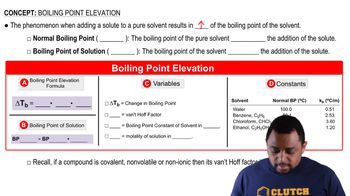
Use the boiling point elevation formula: \( \Delta T_b = i \cdot K_b \cdot m \), where \( \Delta T_b \) is the boiling point elevation, \( i \) is the van't Hoff factor, \( K_b \) is the ebullioscopic constant, and \( m \) is the molality of the solution.
Calculate \( \Delta T_b \) by subtracting the normal boiling point of water (373.15 K) from the given boiling point of the solution (375.3 K).
Assume the van't Hoff factor \( i \) is 1 for a nonvolatile solute that does not dissociate.
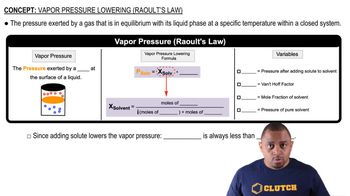
Use Raoult's Law to find the vapor pressure of water above the solution: \( P_{solution} = \chi_{solvent} \cdot P^0_{solvent} \), where \( \chi_{solvent} \) is the mole fraction of the solvent and \( P^0_{solvent} \) is the vapor pressure of pure water at 338 K.

Verified video answer for a similar problem:

This video solution was recommended by our tutors as helpful for the problem above.
Was this helpful?

Key Concepts

Here are the essential concepts you must grasp in order to answer the question correctly.

Raoult's Law

Raoult's Law states that the vapor pressure of a solvent in a solution is directly proportional to the mole fraction of the solvent present. For a nonvolatile solute, the presence of the solute lowers the vapor pressure of the solvent compared to its pure state. This principle is essential for calculating the vapor pressure of the solvent above a solution.
Recommended video:
Guided course
02:40
Raoult's Law and Vapor Pressure

Boiling Point Elevation

Boiling point elevation is a colligative property that describes how the boiling point of a solvent increases when a nonvolatile solute is added. The extent of this elevation depends on the number of solute particles in the solution, not their identity. Understanding this concept helps in relating the boiling point of the solution to the concentration of the solute.
Recommended video:
Guided course
03:05
Boiling Point Elevation

Vapor Pressure

Vapor pressure is the pressure exerted by a vapor in equilibrium with its liquid or solid form at a given temperature. It is a measure of a substance's tendency to evaporate. In the context of solutions, the vapor pressure of the solvent is affected by the presence of solutes, which can be calculated using Raoult's Law and the known vapor pressure of the pure solvent.
Recommended video:
Guided course
02:40
Raoult's Law and Vapor Pressure