
Ch.13 - Solutions
Tro - Chemistry: A Molecular Approach 4th Edition
Tro4th EditionChemistry: A Molecular ApproachISBN: 9780134112831Not the one you use?Change textbook
Chapter 13, Problem 66

One brand of laundry bleach is an aqueous solution containing 4.55% sodium hypochlorite (NaOCl) by mass. What is the molarity of this solution? (Assume a density of 1.02 g/mL.)

Verified step by step guidance
1
Identify the given information: the mass percent of NaOCl is 4.55%, and the density of the solution is 1.02 g/mL.
Assume a certain volume of the solution to simplify calculations, such as 1 liter (1000 mL).
Calculate the mass of the solution using the density: \( \text{mass} = \text{density} \times \text{volume} \).
Determine the mass of NaOCl in the solution using the mass percent: \( \text{mass of NaOCl} = \frac{4.55}{100} \times \text{mass of solution} \).
Convert the mass of NaOCl to moles using its molar mass: \( \text{moles of NaOCl} = \frac{\text{mass of NaOCl}}{\text{molar mass of NaOCl}} \).

Verified video answer for a similar problem:

This video solution was recommended by our tutors as helpful for the problem above.
Video duration:
4m
Was this helpful?

Key Concepts

Here are the essential concepts you must grasp in order to answer the question correctly.

Molarity

Molarity is a measure of concentration defined as the number of moles of solute per liter of solution. It is expressed in moles per liter (mol/L) and is crucial for understanding how much solute is present in a given volume of solution. To calculate molarity, one must know the mass of the solute, its molar mass, and the total volume of the solution.
Recommended video:

Density

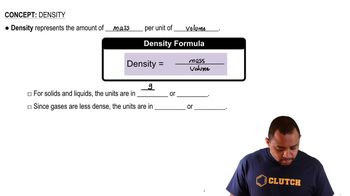
Density is the mass of a substance per unit volume, typically expressed in grams per milliliter (g/mL) or kilograms per cubic meter (kg/m³). In this context, the density of the bleach solution allows us to convert the mass of the solution into volume, which is necessary for calculating molarity. Knowing the density helps in determining how much solution corresponds to a given mass.
Recommended video:
Guided course
01:56
Density Concepts

Percent by Mass

Percent by mass is a way to express the concentration of a component in a mixture, calculated as the mass of the solute divided by the total mass of the solution, multiplied by 100. In this question, the 4.55% sodium hypochlorite indicates that there are 4.55 grams of NaOCl in every 100 grams of the solution. This information is essential for determining the amount of solute present for molarity calculations.
Related Practice
Textbook Question

A solution contains a mixture of pentane and hexane at room temperature. The solution has a vapor pressure of 258 torr. Pure pentane and hexane have vapor pressures of 425 torr and 151 torr, respectively, at room temperature. What is the mole fraction composition of the mixture? (Assume ideal behavior.)

3035
views
1
comments
Textbook Question

A solution contains 50.0 g of heptane (C7H16) and 50.0 g of octane (C8H18) at 25 °C. The vapor pressures of pure heptane and pure octane at 25 °C are 45.8 torr and 10.9 torr, respectively. Assuming ideal behavior, answer the following: d. Why is the composition of the vapor different from the composition of the solution?

1207
views
Textbook Question

Household hydrogen peroxide is an aqueous solution containing 3.0% hydrogen peroxide by mass. What is the molarity of this solution? (Assume a density of 1.01 g/mL.)

1802
views
1
rank
Textbook Question

A solution is prepared by dissolving 20.2 mL of methanol (CH3OH) in 100.0 mL of water at 25 °C. The final volume of the solution is 118 mL. The densities of methanol and water at this temperature are 0.782 g/mL and 1.00 g/mL, respectively. For this solution, calculate the concentration in each unit. e. mole percent

334
views
Textbook Question

A solution is prepared by dissolving 20.2 mL of methanol (CH3OH) in 100.0 mL of water at 25 °C. The final volume of the solution is 118 mL. The densities of methanol and water at this temperature are 0.782 g/mL and 1.00 g/mL, respectively. For this solution, calculate the concentration in each unit. d. mole fraction

2030
views
Textbook Question

An aqueous solution contains 36% HCl by mass. Calculate the molality and mole fraction of the solution.

1601
views