
The desorption (leaving of the surface) of a single molecular layer of n-butane from a single crystal of aluminum oxide is found to be first order with a rate constant of 0.128/s at 150 K. b. If the surface is initially completely covered with n-butane at 150 K, how long will it take for 25% of the molecules to desorb (leave the surface)? For 50% to desorb?
Ch.14 - Chemical Kinetics
Chapter 14, Problem 95d
Consider this energy diagram:
d. Is the overall reaction endothermic or exothermic?
Verified step by step guidance1
Identify the energy levels of the reactants and products on the energy diagram.
Determine the relative positions of the reactants and products: if the products are at a lower energy level than the reactants, the reaction is exothermic; if higher, it is endothermic.
Look for the energy difference between the reactants and products, which is the enthalpy change (\( \Delta H \)).
If \( \Delta H \) is negative, the reaction releases energy and is exothermic. If \( \Delta H \) is positive, the reaction absorbs energy and is endothermic.
Conclude whether the reaction is endothermic or exothermic based on the sign of \( \Delta H \).
Key Concepts
Here are the essential concepts you must grasp in order to answer the question correctly.
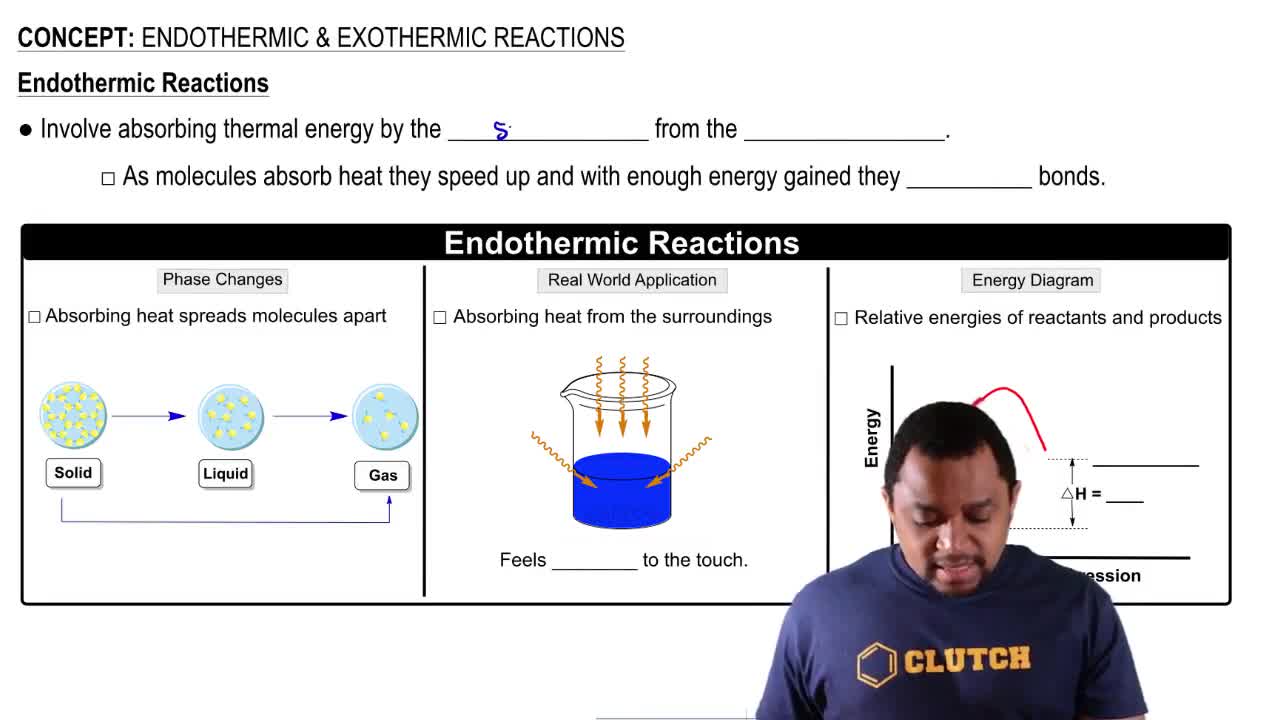
Endothermic and Exothermic Reactions
Endothermic reactions absorb energy from their surroundings, resulting in a decrease in temperature of the environment. Conversely, exothermic reactions release energy, often in the form of heat, leading to an increase in the temperature of the surroundings. Understanding whether a reaction is endothermic or exothermic is crucial for interpreting energy diagrams.
Recommended video:
Guided course
Endothermic & Exothermic Reactions
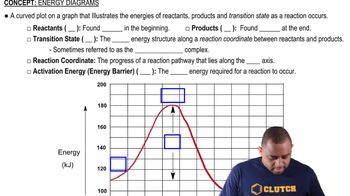
Energy Diagrams
Energy diagrams visually represent the energy changes during a chemical reaction. They typically show the energy of reactants and products, along with the activation energy required for the reaction to proceed. The position of the products relative to the reactants indicates whether the reaction is endothermic (products higher in energy) or exothermic (products lower in energy).
Recommended video:
Guided course
Energy Diagrams
Activation Energy
Activation energy is the minimum energy required for a reaction to occur. It represents the energy barrier that must be overcome for reactants to transform into products. In energy diagrams, this is depicted as the peak of the curve, and understanding this concept helps in analyzing the overall energy changes and the nature of the reaction.
Recommended video:
Guided course
Activity Series Chart
Related Practice
Textbook Question
654
views
Textbook Question
Consider this energy diagram:
<IMAGE>
c. Which step is rate limiting?
Textbook Question
Consider this energy diagram:
<IMAGE>
b. Label the reactants, products, and intermediates.
Textbook Question
Consider the reaction in which HCl adds across the double bond of ethene: HCl + H2C=CH2 → H3C-CH2Cl The following mechanism, with the accompanying energy diagram, has been suggested for this reaction:
Step 1 HCl + H2C=CH2 → H3C=CH2+ + Cl-
Step 2 H3C=CH2+ + Cl- → H3C-CH2Cl
b. What is the expected order of the reaction based on the proposed mechanism?
585
views
