
Ch.14 - Chemical Kinetics
Tro - Chemistry: A Molecular Approach 4th Edition
Tro4th EditionChemistry: A Molecular ApproachISBN: 9780134112831Not the one you use?Change textbook
Chapter 14, Problem 99b

The kinetics of this reaction were studied as a function of temperature. (The reaction is first order in each reactant and second order overall.)
C2H5Br(aq) + OH- (aq) → C2H5OH(l) + Br- (aq)
Temperature (°C) k (L,mol •s)
25 8.81⨉10-5
35 0.000285
45 0.000854
55 0.00239
65 0.00633
b. Determine the rate constant at 15 °C.

Verified step by step guidance
1
Identify that the problem involves determining the rate constant at a different temperature using the Arrhenius equation.
The Arrhenius equation is given by: k = A * e^(-Ea/(RT)), where k is the rate constant, A is the pre-exponential factor, Ea is the activation energy, R is the gas constant (8.314 J/mol*K), and T is the temperature in Kelvin.
To find the rate constant at 15 °C, first convert the temperatures from Celsius to Kelvin by adding 273.15 to each temperature.
Use the given rate constants at different temperatures to plot ln(k) versus 1/T (in Kelvin) and determine the slope, which is equal to -Ea/R.
Once the activation energy (Ea) is determined, use the Arrhenius equation to calculate the rate constant at 15 °C by substituting the values of Ea, R, and the temperature in Kelvin into the equation.

Verified video answer for a similar problem:

This video solution was recommended by our tutors as helpful for the problem above.
Video duration:
3m
Was this helpful?

Key Concepts

Here are the essential concepts you must grasp in order to answer the question correctly.

Reaction Order

The order of a reaction refers to the power to which the concentration of a reactant is raised in the rate law. In this case, the reaction is first order in each reactant, meaning the rate is directly proportional to the concentration of each reactant. Understanding reaction order is crucial for determining how changes in concentration affect the reaction rate.
Recommended video:
Guided course
00:36
Average Bond Order

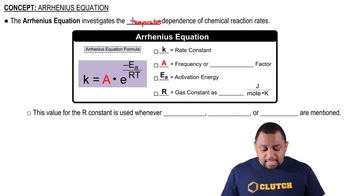
Arrhenius Equation

The Arrhenius equation describes how the rate constant (k) of a reaction changes with temperature. It is expressed as k = A * e^(-Ea/RT), where A is the pre-exponential factor, Ea is the activation energy, R is the gas constant, and T is the temperature in Kelvin. This relationship allows us to estimate the rate constant at different temperatures, which is essential for solving the given problem.
Recommended video:
Guided course
01:20
Arrhenius Equation

Rate Constant (k)

The rate constant (k) is a proportionality factor in the rate law that relates the rate of a reaction to the concentrations of the reactants. It varies with temperature and is specific to each reaction. In this question, determining the rate constant at 15 °C requires understanding how k changes with temperature, which can be inferred from the provided data.
Recommended video:
Guided course
01:14
Equilibrium Constant K
Related Practice
Textbook Question

The kinetics of this reaction were studied as a function of temperature. (The reaction is first order in each reactant and second order overall.)

C2H5Br(aq) + OH- (aq) → C2H5OH(l) + Br- (aq)

Temperature (°C) k (L,mol •s)

25 8.81⨉10-5

35 0.000285

45 0.000854

55 0.00239

65 0.00633

a. Determine the activation energy and frequency factor for the reaction.

Textbook Question

The kinetics of this reaction were studied as a function of temperature. (The reaction is first order in each reactant and second order overall.)

C2H5Br(aq) + OH- (aq) → C2H5OH(l) + Br- (aq)

Temperature (°C) k (L,mol •s)

25 8.81⨉10-5

35 0.000285

45 0.000854

55 0.00239

65 0.00633

c. If a reaction mixture is 0.155 M in C2H5Brand 0.250 M in OH-, what is the initial rate of the reaction at 75 °C?

Textbook Question

Consider the two reactions:

O + N2 → NO + N Ea = 315 kJ/mol

Cl + H2 → HCl + H Ea = 23 kJ/mol

a. Why is the activation barrier for the first reaction so much higher than that for the second?

561
views
Textbook Question

The evaporation of a 120-nm film of n-pentane from a single crystal of aluminum oxide is zero order with a rate constant of 1.92⨉1013 molecules/cm2•s at 120 K. a. If the initial surface coverage is 8.9⨉1016 molecules/cm2, how long will it take for one-half of the film to evaporate?

881
views
1
rank
Textbook Question

Consider the two reactions:

O + N2 → NO + N Ea = 315 kJ/mol

Cl + H2 → HCl + H Ea = 23 kJ/mol

b. The frequency factors for these two reactions are very close to each other in value. Assuming that they are the same, calculate the ratio of the reaction rate constants for these two reactions at 25 °C.

689
views