
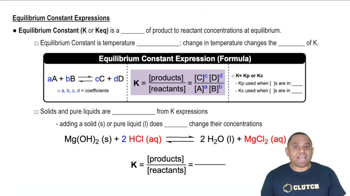
Carbon monoxide replaces oxygen in oxygenated hemoglobin according to the reaction: HbO2(aq) + CO(aq) ⇌ HbCO(aq) + O2(aq) a. Use the reactions and associated equilibrium constants at body temperature given here to find the equilibrium constant for the reaction just shown. Hb(aq) + O2(aq) ⇌ HbO2(aq) Kc = 1.8 Hb(aq) + CO(aq) ⇌ HbCO(aq) Kc = 306
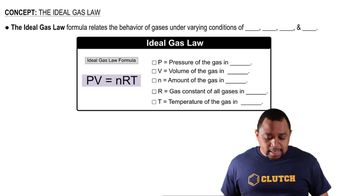
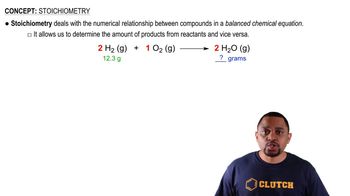
The reaction CO2(g) + C(s) ⇌ 2 CO(g) has Kp = 5.78 at 1200 K. a. Calculate the total pressure at equilibrium when 4.45 g of CO2 is introduced into a 10.0-L container and heated to 1200 K in the presence of 2.00 g of graphite. b. Repeat the calculation of part a in the presence of 0.50 g of graphite.
Verified step by step guidanceKey Concepts
Equilibrium Constant (Kp)
Ideal Gas Law
Stoichiometry of the Reaction
At 650 K, the reaction MgCO3(s) ⇌ MgO(s) + CO2(g) has Kp = 0.026. A 10.0-L container at 650 K has 1.0 g of MgO(s) and CO2 at P = 0.0260 atm. The container is then compressed to a volume of 0.100 L. Find the mass of MgCO3 that is formed.
Coal, which is primarily carbon, can be converted to natural gas, primarily CH4, by the exothermic reaction: C(s) + 2 H2(g) ⇌ CH4(g) Which disturbance will favor CH4 at equilibrium?
a. adding more C to the reaction mixture b. adding more H2 to the reaction mixture d. lowering the volume of the reaction mixture f. adding neon gas to the reaction mixture
Consider the endothermic reaction: C2H4(g) + I2(g) ⇌ C2H4I2(g) If you were trying to maximize the amount of C2H4I2 produced, which tactic might you try? Assume that the reaction mixture reaches equilibrium. a. decreasing the reaction volume b. removing I2 from the reaction mixture c. raising the reaction temperature d. adding C2H4 to the reaction mixture
Coal, which is primarily carbon, can be converted to natural gas, primarily CH4, by the exothermic reaction: C(s) + 2 H2(g) ⇌ CH4(g) Which disturbance will favor CH4 at equilibrium? c. raising the temperature of the reaction mixture
