Ch.16 - Acids and Bases
Tro - Chemistry: A Molecular Approach 4th Edition
Tro4th EditionChemistry: A Molecular ApproachISBN: 9780134112831Not the one you use?Change textbook
Chapter 16, Problem 114

Calculate the concentration of all species in a 0.155 M solution of H2CO3.

Verified step by step guidance
1
Identify the dissociation steps of carbonic acid (H2CO3) in water: H2CO3 can dissociate in two steps: first into HCO3^- and H^+, and then HCO3^- can further dissociate into CO3^2- and H^+.
Write the equilibrium expressions for each dissociation step: For the first dissociation, H2CO3 ⇌ HCO3^- + H^+, the equilibrium constant is Ka1. For the second dissociation, HCO3^- ⇌ CO3^2- + H^+, the equilibrium constant is Ka2.
Set up the initial concentrations and changes for each species: Initially, [H2CO3] = 0.155 M, [HCO3^-] = 0, [CO3^2-] = 0, and [H^+] = 0. Use 'x' to represent the change in concentration for the first dissociation and 'y' for the second.
Apply the equilibrium expressions to solve for 'x' and 'y': Use the expressions Ka1 = [HCO3^-][H^+]/[H2CO3] and Ka2 = [CO3^2-][H^+]/[HCO3^-] to find the values of 'x' and 'y'.
Calculate the equilibrium concentrations: Use the values of 'x' and 'y' to determine the concentrations of all species at equilibrium: [H2CO3] = 0.155 - x, [HCO3^-] = x - y, [CO3^2-] = y, and [H^+] = x + y.

Verified video answer for a similar problem:

This video solution was recommended by our tutors as helpful for the problem above.
Video duration:
17m
Was this helpful?

Key Concepts

Here are the essential concepts you must grasp in order to answer the question correctly.

Acid-Base Chemistry

Acid-base chemistry involves the study of acids, bases, and their reactions. In this context, H2CO3 (carbonic acid) is a weak acid that partially dissociates in solution to produce H+ ions and HCO3- ions. Understanding the dissociation of weak acids is crucial for calculating the concentrations of all species in the solution.
Recommended video:
Guided course
02:00
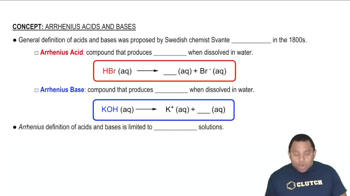
Arrhenius Acids and Bases

Dissociation Equilibrium

Dissociation equilibrium refers to the state where the rate of dissociation of a compound into its ions equals the rate of recombination of those ions into the compound. For H2CO3, the dissociation can be represented as H2CO3 ⇌ H+ + HCO3-. The equilibrium constant (Ka) helps determine the concentrations of the ions at equilibrium, which is essential for solving the problem.

Concentration Calculations

Concentration calculations involve determining the amount of solute present in a given volume of solution. In this case, starting with a 0.155 M solution of H2CO3, one must apply the principles of stoichiometry and equilibrium to find the concentrations of H+, HCO3-, and any undissociated H2CO3. This requires an understanding of molarity and how it relates to the dissociation of the acid.
Recommended video:
Guided course
07:35
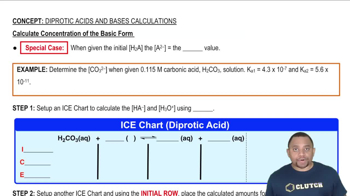
Calculate Concentration of the Basic Form