Use the appropriate values of Ksp and Kf to find the equilibrium constant for the reaction. PbCl2(s) + 3 OH-(aq) ⇌ Pb(OH)3-(aq) + 2 Cl-(aq)

Ch.17 - Aqueous Ionic Equilibrium
Chapter 17, Problem 115
A buffer is created by combining 150.0 mL of 0.25 M HCHO2 with 75.0 mL of 0.20 M NaOH. Determine the pH of the buffer.
Verified step by step guidance1
Calculate the moles of HCHO2 by multiplying its concentration (0.25 M) by its volume (0.150 L).
Calculate the moles of NaOH by multiplying its concentration (0.20 M) by its volume (0.075 L).
Determine the moles of HCHO2 that react with NaOH, noting that NaOH is a strong base and will react completely with HCHO2.
Calculate the moles of the conjugate base (CHO2-) formed from the reaction of HCHO2 with NaOH.
Use the Henderson-Hasselbalch equation, \( \text{pH} = \text{pK}_a + \log \left( \frac{[\text{A}^-]}{[\text{HA}]} \right) \), to find the pH of the buffer, where \([\text{A}^-]\) is the concentration of the conjugate base and \([\text{HA}]\) is the concentration of the remaining acid.
Key Concepts
Here are the essential concepts you must grasp in order to answer the question correctly.
Buffer Solutions
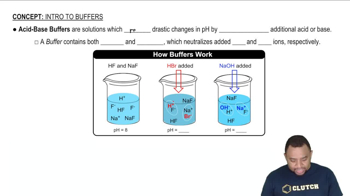
A buffer solution is a system that resists changes in pH upon the addition of small amounts of acid or base. It typically consists of a weak acid and its conjugate base or a weak base and its conjugate acid. In this case, the combination of formic acid (HCHO2) and sodium hydroxide (NaOH) creates a buffer that can maintain a relatively stable pH.
Recommended video:
Guided course
Buffer Solutions
Henderson-Hasselbalch Equation
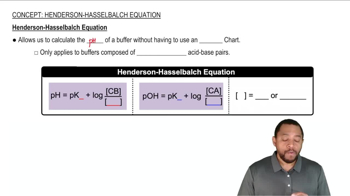
The Henderson-Hasselbalch equation is a mathematical formula used to calculate the pH of a buffer solution. It is expressed as pH = pKa + log([A-]/[HA]), where pKa is the negative logarithm of the acid dissociation constant, [A-] is the concentration of the conjugate base, and [HA] is the concentration of the weak acid. This equation is essential for determining the pH of the buffer created in the question.
Recommended video:
Guided course
Henderson-Hasselbalch Equation
Stoichiometry of Acid-Base Reactions
Stoichiometry involves the calculation of reactants and products in chemical reactions. In the context of the buffer solution, it is important to determine how much of the weak acid (HCHO2) and its conjugate base (from the NaOH) are present after the reaction. This allows for the correct concentrations to be used in the Henderson-Hasselbalch equation to find the final pH of the buffer.
Recommended video:
Guided course
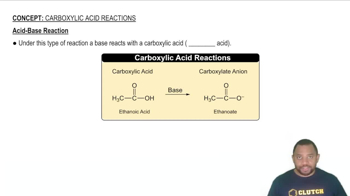
Acid-Base Reaction
Related Practice
Textbook Question
Textbook Question
A 1.0-L buffer solution initially contains 0.25 mol of NH3 and 0.25 mol of NH4Cl. In order to adjust the buffer pH to 8.75, should you add NaOH or HCl to the buffer mixture? What mass of the correct reagent should you add?
2807
views
Textbook Question
In analytical chemistry, bases used for titrations must often be standardized; that is, their concentration must be precisely determined. Standardization of sodium hydroxide solutions can be accomplished by titrating potassium hydrogen phthalate (KHC8H4O4), also known as KHP, with the NaOH solution to be standardized. b. The titration of 0.5527 g of KHP required 25.87 mL of an NaOH solution to reach the equivalence point. What is the concentration of the NaOH solution?
868
views