A solution is made 1.1⨉10-3 M in Zn(NO3)2 and 0.150 M in NH3. After the solution reaches equilibrium, what concentration of Zn2+(aq) remains?
Ch.17 - Aqueous Ionic Equilibrium
Chapter 17, Problem 107b
A solution is 0.010 M in Ba2+ and 0.020 M in Ca2+. b. What is the remaining concentration of the cation that precipitates first, when the other cation begins to precipitate?
Verified step by step guidance1
Identify the solubility products (Ksp) for possible precipitates involving Ba2+ and Ca2+. Common precipitates to consider are BaSO4 and CaSO4.
Write the solubility product expressions for each precipitate. For BaSO4, the expression is Ksp = [Ba2+][SO42-]. For CaSO4, the expression is Ksp = [Ca2+][SO42-].
Calculate the ion product (Q) for each cation with sulfate. Q is calculated using the initial concentrations of the cations. For Ba2+, Q = [Ba2+][SO42-], and for Ca2+, Q = [Ca2+][SO42-].
Compare the ion product (Q) with the solubility product (Ksp) for each cation to determine which precipitate forms first. The cation whose Q exceeds Ksp first will precipitate first.
Calculate the concentration of the cation that precipitates first when the second cation begins to precipitate. Use the Ksp value of the second cation to find the maximum concentration of sulfate ion possible before the second cation starts to precipitate, then use this sulfate concentration to find the remaining concentration of the first cation.

Verified video answer for a similar problem:
This video solution was recommended by our tutors as helpful for the problem above.
Video duration:
6mWas this helpful?
Key Concepts
Here are the essential concepts you must grasp in order to answer the question correctly.
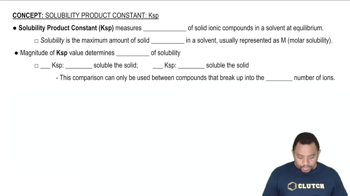
Solubility Product Constant (Ksp)
The solubility product constant (Ksp) is a numerical value that represents the equilibrium between a solid and its ions in a saturated solution. It is specific to a particular ionic compound and is used to predict whether a precipitate will form when two solutions are mixed. The lower the Ksp value, the less soluble the compound is, meaning it will precipitate out of solution at lower concentrations.
Recommended video:
Guided course
Solubility Product Constant
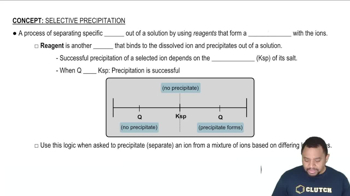
Precipitation Reaction
A precipitation reaction occurs when two soluble salts are mixed, resulting in the formation of an insoluble compound, or precipitate. This process is driven by the decrease in solubility of the ions involved when their concentrations exceed the Ksp. Understanding which cation precipitates first requires knowledge of the Ksp values of the potential precipitates formed from the cations in the solution.
Recommended video:
Guided course
Selective Precipitation
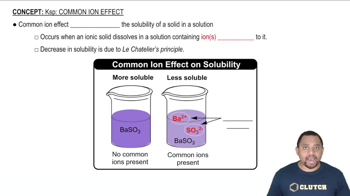
Common Ion Effect
The common ion effect refers to the decrease in solubility of a salt when a common ion is added to the solution. In the context of precipitation, the presence of a common ion shifts the equilibrium, favoring the formation of the solid precipitate. This concept is crucial for determining which cation will precipitate first, as the concentration of one cation can influence the solubility of the other.
Recommended video:
Guided course
Common Ion Effect
Related Practice
Textbook Question
1060
views
Textbook Question
Determine the minimum concentration of the precipitating agent on the right to cause precipitation of the cation from the solution on the left. b. 0.085 M CaI2; K2SO4
561
views
Textbook Question
Use the appropriate values of Ksp and Kf to find the equilibrium constant for the reaction. PbCl2(s) + 3 OH-(aq) ⇌ Pb(OH)3-(aq) + 2 Cl-(aq)
Textbook Question
Use the appropriate values of Ksp and Kf to find the equilibrium constant for the reaction. FeS(s) + 6 CN-(aq) ⇌ Fe(CN)64-(aq) + S2-(aq)
1568
views
Textbook Question
Determine the minimum concentration of the precipitating agent on the right to cause precipitation of the cation from the solution on the left. a. 0.035 M Ba(NO3)2; NaF
2167
views
1
comments