
Dinitrogen tetroxide decomposes to nitrogen dioxide: N2O4(g) → 2 NO2(g) ΔH°rxn = 55.3 kJ At 298 K, a reaction vessel initially contains 0.100 atm of N2O4. When equilibrium is reached, 58% of the N2O4 has decomposed to NO2. What percentage of N2O4 decomposes at 388 K? Assume that the initial pressure of N2O4 is the same (0.100 atm).
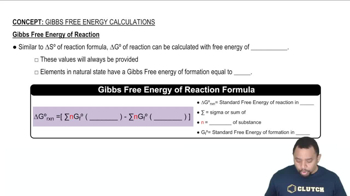
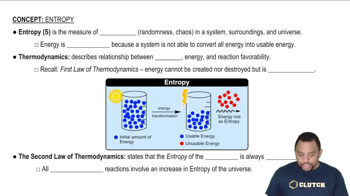
All the oxides of nitrogen have positive values of ΔG°f at 298 K, but only one common oxide of nitrogen has a positive ΔS°f. Identify that oxide of nitrogen without reference to thermodynamic data and explain.
Verified step by step guidance
Verified video answer for a similar problem:
Key Concepts
Gibbs Free Energy (ΔGf°)
Entropy (ΔS°f)
Nitrogen Oxides
Living organisms use energy from the metabolism of food to create an energy-rich molecule called adenosine triphosphate (ATP). The ATP acts as an energy source for a variety of reactions that the living organism must carry out to survive. ATP provides energy through its hydrolysis, which can be symbolized as follows: ATP(aq) + H2O(l) → ADP(aq) + Pi(aq) ΔG°rxn = -30.5 kJ where ADP represents adenosine diphosphate and Pi represents an inorganic phosphate group (such as HPO42-). b. The free energy obtained from the oxidation (reaction with oxygen) of glucose (C6H12O6) to form carbon dioxide and water can be used to re-form ATP by driving the given reaction in reverse. Calculate the standard free energy change for the oxidation of glucose and estimate the maximum number of moles of ATP that can be formed by the oxidation of one mole of glucose.
These reactions are important in catalytic converters in automobiles. Calculate ΔG° for each at 298 K. Predict the effect of increasing temperature on the magnitude of ΔG°.
a. 2 CO(g) + 2 NO(g) → N2(g) + 2 CO2(g)
b. 5 H2(g) + 2 NO(g) → 2 NH3(g) + 2 H2O(g)
c. 2 H2(g) + 2 NO(g) → N2(g) + 2 H2O(g)
d. 2 NH3(g) + 2 O2(g) → N2O(g) + 3 H2O(g)
The values of ΔG°f for the hydrogen halides become less negative with increasing atomic number. The ΔG°f of HI is slightly positive. However, the trend in ΔS°f is to become more positive with increasing atomic number. Explain.
