Consider the reaction: CO2(g) + CCl4(g) ⇌ 2 COCl2(g) Calculate ΔG for this reaction at 25 °C under the following conditions: i. PCO2 = 0.112 atm ii. PCCl4 = 0.174 atm iii. PCOCl2 = 0.744 atm
Ch.18 - Free Energy and Thermodynamics
Chapter 18, Problem 71
Consider the reaction: CH3OH(g) → CO(g) + 2 H2(g). Calculate ΔG for this reaction at 25 °C under the following conditions: i. PCH3OH = 0.855 atm ii. PCO = 0.125 atm iii. PH2 = 0.183 atm.
Verified step by step guidance1
Key Concepts
Here are the essential concepts you must grasp in order to answer the question correctly.
Gibbs Free Energy (ΔG)
Gibbs Free Energy (ΔG) is a thermodynamic potential that measures the maximum reversible work obtainable from a thermodynamic system at constant temperature and pressure. It is a crucial concept in predicting the spontaneity of a reaction; a negative ΔG indicates that a reaction can occur spontaneously, while a positive ΔG suggests non-spontaneity.
Recommended video:
Guided course
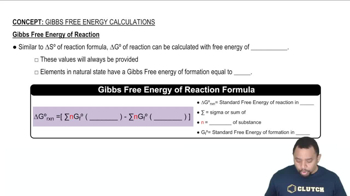
Gibbs Free Energy of Reactions
Reaction Quotient (Q)
The reaction quotient (Q) is a ratio that compares the concentrations or partial pressures of the products to the reactants at any point in a reaction. It is used to determine the direction in which a reaction will proceed to reach equilibrium. For the given reaction, Q can be calculated using the partial pressures of the gases involved.
Recommended video:
Guided course
Reaction Quotient Q
Standard Gibbs Free Energy Change (ΔG°)
The standard Gibbs free energy change (ΔG°) is the change in Gibbs free energy for a reaction under standard conditions (1 atm pressure, 25 °C). It serves as a reference point for calculating ΔG under non-standard conditions using the equation ΔG = ΔG° + RT ln(Q), where R is the gas constant and T is the temperature in Kelvin.
Recommended video:
Guided course
Standard Gibbs Free Energy and Temperature
Related Practice
Textbook Question
2712
views
1
comments
Textbook Question
Use data from Appendix IIB to calculate the equilibrium constants at 25 °C for each reaction. a. 2 CO(g) + O2(g) ⇌ 2 CO2(g)
2420
views
1
rank
Textbook Question
Consider the evaporation of methanol at 25.0 °C : CH3OH(l) → CH3OH(g) b. Find ΔGr at 25.0 °C under the following nonstandard conditions: i. PCH3OH = 150.0 mmHg ii. PCH3OH = 100.0 mmHg iii. PCH3OH = 10.0 mmHg
2431
views
Textbook Question
Consider the evaporation of methanol at 25.0 °C : CH3OH(l) → CH3OH(g) a. Find ΔG°r at 25.0 °C.
2543
views
Textbook Question
Consider the evaporation of methanol at 25.0 °C : CH3OH(l) → CH3OH(g) c. Explain why methanol spontaneously evaporates in open air at 25.0 °C
617
views
Textbook Question
Use data from Appendix IIB to calculate the equilibrium constants at 25 °C for each reaction. b. 2 H2S(g) ⇌ 2 H2(g) + S2(g)
551
views