
Given the values of ΔH°rxn, ΔS°rxn, and T, determine ΔSuniv and predict whether or not each reaction is spontaneous. (Assume that all reactants and products are in their standard states.) a. ΔH°rxn = -95 kJ; ΔS°rxn = -157 J/K; T = 298 K
Ch.18 - Free Energy and Thermodynamics
Chapter 18, Problem 42c
Given the values of ΔH°rxn, ΔS°rxn, and T, determine ΔSuniv and predict whether or not each reaction is spontaneous. (Assume that all reactants and products are in their standard states.) c. ΔH°rxn = +95 kJ; ΔS°rxn = -157 J/K; T = 298 K
Verified step by step guidance1
First, we need to convert ΔH°rxn from kJ to J because ΔS°rxn is given in J/K. We can do this by multiplying the given ΔH°rxn by 1000. So, ΔH°rxn = +95 kJ * 1000 = +95000 J.
Next, we calculate ΔSuniv using the formula ΔSuniv = ΔS°rxn - (ΔH°rxn/T). Plug in the given values: ΔSuniv = -157 J/K - (+95000 J/298 K).
Calculate the value of ΔSuniv from the above expression.
If ΔSuniv is positive, the reaction is spontaneous. If ΔSuniv is negative, the reaction is non-spontaneous.
Finally, based on the value of ΔSuniv, predict whether the reaction is spontaneous or not.

Verified video answer for a similar problem:
This video solution was recommended by our tutors as helpful for the problem above.
Video duration:
5mWas this helpful?
Key Concepts
Here are the essential concepts you must grasp in order to answer the question correctly.
Gibbs Free Energy
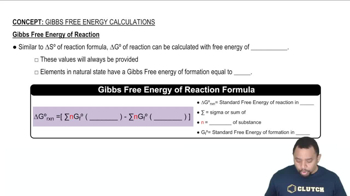
Gibbs Free Energy (G) is a thermodynamic potential that helps predict the spontaneity of a reaction at constant temperature and pressure. It is calculated using the equation ΔG = ΔH - TΔS, where ΔH is the change in enthalpy, T is the temperature in Kelvin, and ΔS is the change in entropy. A negative ΔG indicates a spontaneous reaction, while a positive ΔG suggests non-spontaneity.
Recommended video:
Guided course
Gibbs Free Energy of Reactions
Entropy (ΔS)
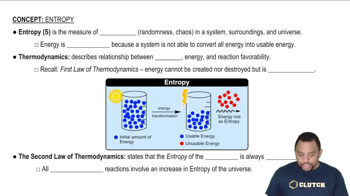
Entropy (ΔS) is a measure of the disorder or randomness in a system. In the context of a chemical reaction, a positive ΔS indicates an increase in disorder, which favors spontaneity. Conversely, a negative ΔS suggests a decrease in disorder, which can hinder spontaneity. The change in entropy is crucial for determining the overall spontaneity of a reaction when combined with enthalpy changes.
Recommended video:
Guided course
Entropy in Thermodynamics
Enthalpy (ΔH)
Enthalpy (ΔH) is a measure of the total heat content of a system and reflects the energy absorbed or released during a reaction. A positive ΔH indicates that the reaction is endothermic, absorbing heat from the surroundings, while a negative ΔH indicates an exothermic reaction, releasing heat. The sign and magnitude of ΔH are essential for evaluating the energy changes that influence the spontaneity of a reaction in conjunction with entropy.
Related Practice
Textbook Question
1500
views
Textbook Question
Given the values of ΔH°rxn, ΔS°rxn, and T, determine ΔSuniv and predict whether or not each reaction is spontaneous. (Assume that all reactants and products are in their standard states.) c. ΔH°rxn = -115 kJ; ΔS°rxn = -263 J/K; T = 298 K
1060
views
Textbook Question
Calculate the free energy change for this reaction at 25 °C. Is the reaction spontaneous? (Assume that all reactants and products are in their standard states.) C3H8(g) + 5 O2(g) → 3 CO2(g) + 4 H2O(g) ΔH°rxn = -2217 kJ; ΔS°rxn = 101.1 J/K
Textbook Question
Calculate the change in Gibbs free energy for each of the sets of ΔHrxn, ΔSrxn, and T given in Problem 42. Predict whether or not each reaction is spontaneous at the temperature indicated. (Assume that all reactants and products are in their standard states.)
3067
views
