A metal forms the fluoride MF3. Electrolysis of the molten fluo- ride by a current of 3.86 A for 16.2 minutes deposits 1.25 g of the metal. Calculate the molar mass of the metal.
Ch.19 - Electrochemistry
Chapter 19, Problem 126
A 0.0251-L sample of a solution of Cu+ requires 0.0322 L of 0.129 M KMnO4 solution to reach the equivalence point. The products of the reaction are Cu2+ and Mn2+. What is the concentration of the Cu+ solution?
Verified step by step guidance1
Identify the balanced chemical equation for the reaction: \[ 5 \text{Cu}^+ + \text{MnO}_4^- + 8\text{H}^+ \rightarrow 5\text{Cu}^{2+} + \text{Mn}^{2+} + 4\text{H}_2\text{O} \]
Calculate the moles of \( \text{KMnO}_4 \) used: \[ \text{moles of } \text{KMnO}_4 = 0.0322 \text{ L} \times 0.129 \text{ M} \]
Use the stoichiometry of the balanced equation to find the moles of \( \text{Cu}^+ \): \[ \text{moles of } \text{Cu}^+ = 5 \times \text{moles of } \text{KMnO}_4 \]
Calculate the concentration of \( \text{Cu}^+ \) in the original solution: \[ \text{Concentration of } \text{Cu}^+ = \frac{\text{moles of } \text{Cu}^+}{0.0251 \text{ L}} \]
Review the steps to ensure all calculations align with the stoichiometry and the given data.
Key Concepts
Here are the essential concepts you must grasp in order to answer the question correctly.
Stoichiometry
Stoichiometry is the branch of chemistry that deals with the quantitative relationships between the reactants and products in a chemical reaction. It allows us to calculate the amounts of substances consumed and produced in a reaction based on balanced chemical equations. Understanding stoichiometry is essential for determining the concentration of solutions and the volumes of reactants needed to reach equivalence points in titrations.
Recommended video:
Guided course
Stoichiometry Concept
Titration
Titration is a laboratory technique used to determine the concentration of a solute in a solution by reacting it with a solution of known concentration. The point at which the reaction is complete is called the equivalence point, which can be identified using indicators or pH meters. In this question, the titration of Cu+ with KMnO4 allows us to find the concentration of the Cu+ solution based on the volume and molarity of the titrant used.
Recommended video:
Guided course
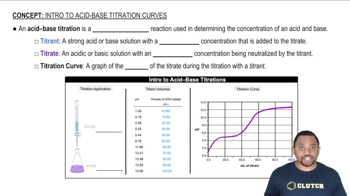
Acid-Base Titration
Molarity
Molarity is a measure of concentration defined as the number of moles of solute per liter of solution. It is expressed in units of moles per liter (M). In this problem, the molarity of the KMnO4 solution is crucial for calculating the moles of KMnO4 used in the titration, which can then be related to the moles of Cu+ in the original solution to find its concentration.
Recommended video:
Guided course
Molarity
Related Practice
Textbook Question
736
views
Textbook Question
A sample of impure tin of mass 0.535 g is dissolved in strong acid to give a solution of Sn2+. The solution is then titrated with a 0.0448 M solution of NO3–, which is reduced to NO(g). The equivalence point is reached upon the addition of 0.0344 L of the NO3– solution. Find the percent by mass of tin in the original sample, assuming that it contains no other reducing agents.
939
views
1
rank
Textbook Question
A current of 11.3 A is applied to 1.25 L of a solution of 0.552 M HBr converting some of the H+ to H2(g), which bubles out of solution. What is the pH of the solution after 73 minutes?
792
views
Textbook Question
To what pH should you adjust a standard hydrogen electrode to get an electrode potential of -0.122 V? (Assume that the partial pressure of hydrogen gas remains at 1 atm.)
707
views