Silver can be electroplated at the cathode of an electrolysis cell by the half-reaction: Ag+(aq) + e– → Ag(s) What mass of silver would plate onto the cathode if a current of 6.8 A flowed through the cell for 72 min?
Ch.19 - Electrochemistry
Chapter 19, Problem 104
Consider the reaction shown here occurring at 25°C. Cr(s) + Cd2+(aq) → Cr2+(aq) + Cd(s) Determine E°cell, K, and ∆G°rxn for the reaction and complete the table.
[Cd2+] [Cr2+] Q Ecell 𝚫Grxn
1.00 1.00
1.00 1.00 × 10⁻⁵
1.00 × 10⁻⁵ 1.00
4.18 × 10⁻⁴ 1.00

Verified step by step guidance1
Step 1: Write the half-reactions for the given redox reaction. For Cr(s) to Cr2+(aq) and Cd2+(aq) to Cd(s).
Step 2: Determine the standard reduction potentials (E°) for each half-reaction from a standard reduction potential table.
Step 3: Calculate the standard cell potential (E°cell) using the formula E°cell = E°cathode - E°anode.
Step 4: Calculate the reaction quotient (Q) for each set of concentrations using the formula Q = [products]/[reactants].
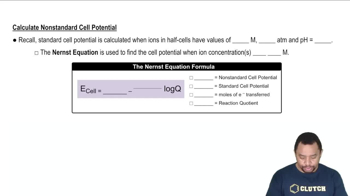
Step 5: Use the Nernst equation to calculate the cell potential (Ecell) for each set of concentrations: Ecell = E°cell - (RT/nF) * ln(Q).

Verified video answer for a similar problem:
This video solution was recommended by our tutors as helpful for the problem above.
Video duration:
11mWas this helpful?
Key Concepts
Here are the essential concepts you must grasp in order to answer the question correctly.
Electrochemical Cell
An electrochemical cell is a device that converts chemical energy into electrical energy through redox reactions. It consists of two electrodes, an anode where oxidation occurs, and a cathode where reduction takes place. The flow of electrons from the anode to the cathode generates an electric current, which can be harnessed for work.
Nernst Equation
The Nernst equation relates the cell potential (E) of an electrochemical cell to the standard cell potential (E°) and the reaction quotient (Q). It is expressed as E = E° - (RT/nF)ln(Q), where R is the gas constant, T is the temperature in Kelvin, n is the number of moles of electrons transferred, and F is Faraday's constant. This equation allows for the calculation of cell potential under non-standard conditions.
Recommended video:
Guided course
The Nernst Equation
Gibbs Free Energy (ΔGrxn)
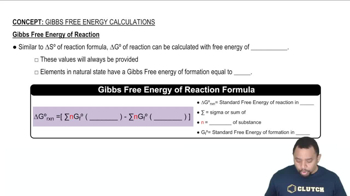
Gibbs free energy (ΔGrxn) is a thermodynamic quantity that indicates the spontaneity of a reaction. It is defined as ΔGrxn = ΔH - TΔS, where ΔH is the change in enthalpy, T is the temperature in Kelvin, and ΔS is the change in entropy. A negative ΔGrxn indicates a spontaneous reaction, while a positive value suggests non-spontaneity. The relationship between ΔGrxn and cell potential (Ecell) is given by ΔGrxn = -nFEcell.
Recommended video:
Guided course
Gibbs Free Energy of Reactions
Related Practice
Textbook Question
2188
views
Textbook Question
Consider the unbalanced redox reaction: Cr2O72-(aq) + Cu(s) → Cr3+(aq) + Cu2+(aq) Balance the equation and determine the volume of a 0.850 M K2Cr2O7 solution required to completely react with 5.25 g of Cu.
2265
views
1
rank
Textbook Question
A major source of sodium metal is the electrolysis of molten sodium chloride. What magnitude of current produces 1.0 kg of sodium metal in 1 hour?
1055
views
Textbook Question
Determine whether HI can dissolve each metal sample. If it can, write a balanced chemical reaction showing how the metal dissolves in HI and determine the minimum volume of 3.5 M HI required to completely dissolve the sample. a. 2.15 g Al
712
views