Calculate ∆G°rxn and K for each reaction. b. The reaction of Cr3+(aq) and Cr(s) to form Cr2+(aq). [The electrode potential of Cr2+(aq) to Cr(s) is -0.91 V.]
Ch.19 - Electrochemistry
Chapter 19, Problem 123
The molar mass of a metal (M) is 50.9 g/mol; it forms a chloride of unknown composition. Electrolysis of a sample of the molten chloride with a current of 6.42 A for 23.6 minutes produces 1.20 g of M at the cathode. Determine the empirical formula of the chloride.
Verified step by step guidance1
Calculate the total charge (Q) passed during electrolysis using the formula Q = I \(\times\) t, where I is the current in amperes and t is the time in seconds.
Convert the time from minutes to seconds by multiplying the given time in minutes by 60.
Use Faraday's laws of electrolysis to determine the moles of electrons transferred. The formula is moles of electrons = \(\frac{Q}{F}\), where F is Faraday's constant (approximately 96485 C/mol).
Determine the moles of metal (M) deposited using the given mass and molar mass of the metal: moles of M = \(\frac{1.20 \text{ g}\)}{50.9 \(\text{ g/mol}\)}.
Assume the metal forms a chloride of the form MCl_x. Use the stoichiometry of the reaction and the moles of electrons to find the value of x, which represents the number of chloride ions per metal ion in the empirical formula.
Key Concepts
Here are the essential concepts you must grasp in order to answer the question correctly.
Molar Mass
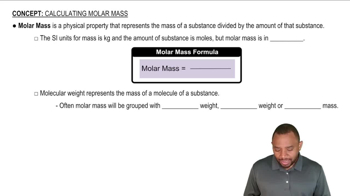
Molar mass is the mass of one mole of a substance, typically expressed in grams per mole (g/mol). It is a crucial concept in stoichiometry, allowing chemists to convert between the mass of a substance and the number of moles. In this question, the molar mass of the metal (M) is given as 50.9 g/mol, which will be used to determine the amount of metal produced during electrolysis.
Recommended video:
Guided course
Molar Mass Concept
Electrolysis
Electrolysis is a chemical process that uses electrical energy to drive a non-spontaneous reaction, typically involving the decomposition of a compound. In this scenario, the electrolysis of the molten chloride produces the metal at the cathode. The amount of metal produced can be calculated using Faraday's laws of electrolysis, which relate the quantity of electric charge to the amount of substance transformed at the electrodes.
Recommended video:
Guided course
The Electrolytic Cell
Empirical Formula
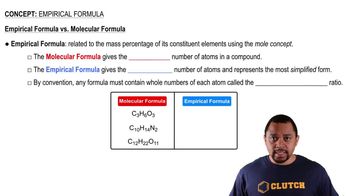
The empirical formula of a compound represents the simplest whole-number ratio of the elements present in that compound. To determine the empirical formula of the chloride formed by the metal, one must calculate the moles of the metal and the corresponding moles of chlorine based on the mass of the metal produced and the stoichiometry of the electrolysis reaction. This ratio will provide insight into the composition of the chloride.
Recommended video:
Guided course
Empirical vs Molecular Formula
Related Practice
Textbook Question
781
views
Textbook Question
A metal forms the fluoride MF3. Electrolysis of the molten fluo- ride by a current of 3.86 A for 16.2 minutes deposits 1.25 g of the metal. Calculate the molar mass of the metal.
736
views
Textbook Question
A sample of impure tin of mass 0.535 g is dissolved in strong acid to give a solution of Sn2+. The solution is then titrated with a 0.0448 M solution of NO3–, which is reduced to NO(g). The equivalence point is reached upon the addition of 0.0344 L of the NO3– solution. Find the percent by mass of tin in the original sample, assuming that it contains no other reducing agents.
939
views
1
rank
Textbook Question
Calculate ∆G°rxn and K for each reaction. a. The reaction of Cr2+(aq) with Cr2O72–(aq) in acid solution to form Cr3+(aq).
894
views