
Calculate the quantity of energy produced per mole of U-235 (atomic mass = 235.043922 amu) for the neutron-induced fission of U-235 to produce Te-137 (atomic mass = 136.9253 amu) and Zr-97 (atomic mass = 96.910950 amu) (discussed in Problem 58).
Ch.20 - Radioactivity and Nuclear Chemistry
Chapter 20, Problem 73
A 75-kg human has a dose of 32.8 rad of radiation. How much energy is absorbed by the person's body? Compare this energy to the amount of energy absorbed by the person's body if he or she jumped from a chair to the floor (assume that the chair is 0.50 m from the ground and that all of the energy from the fall is absorbed by the person).
Verified step by step guidance1
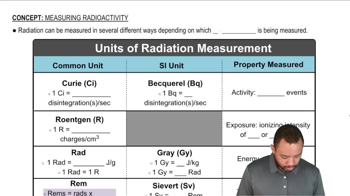
Understand that 1 rad is equivalent to 0.01 joules of energy absorbed per kilogram of tissue.
Calculate the energy absorbed by the body due to radiation using the formula: \( \text{Energy (J)} = \text{dose (rad)} \times \text{mass (kg)} \times 0.01 \text{ J/kg} \).
Substitute the given values into the formula: \( 32.8 \text{ rad} \times 75 \text{ kg} \times 0.01 \text{ J/kg} \).
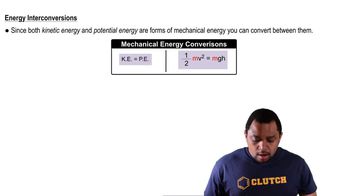
Calculate the potential energy absorbed by the person when jumping from a chair using the formula: \( \text{Potential Energy (PE)} = mgh \), where \( m \) is mass, \( g \) is the acceleration due to gravity (9.8 m/s²), and \( h \) is the height (0.50 m).
Substitute the given values into the potential energy formula: \( 75 \text{ kg} \times 9.8 \text{ m/s}^2 \times 0.50 \text{ m} \).

Verified video answer for a similar problem:
This video solution was recommended by our tutors as helpful for the problem above.
Video duration:
5mWas this helpful?
Key Concepts
Here are the essential concepts you must grasp in order to answer the question correctly.
Radiation Absorption
Radiation absorption refers to the process by which matter takes in energy from radiation. The unit 'rad' measures the amount of energy absorbed per unit mass of tissue, specifically 100 ergs of energy per gram. Understanding this concept is crucial for calculating the total energy absorbed by the human body from radiation exposure.
Recommended video:
Guided course
Units of Radiation Measurement
Gravitational Potential Energy
Gravitational potential energy is the energy an object possesses due to its position in a gravitational field. It can be calculated using the formula PE = mgh, where 'm' is mass, 'g' is the acceleration due to gravity, and 'h' is the height. This concept is essential for determining the energy absorbed by a person when falling from a height, such as jumping from a chair.
Recommended video:
Guided course
Kinetic & Potential Energy
Energy Comparison
Energy comparison involves evaluating different forms of energy absorbed by a system to understand their relative magnitudes. In this context, it requires comparing the energy absorbed from radiation (in rads) to the gravitational potential energy from a fall. This comparison helps illustrate the effects of different energy sources on the human body.
Recommended video:
Guided course
Oxyacid Strength Comparison
Related Practice
Textbook Question
108
views
Textbook Question
Complete each nuclear equation and calculate the energy change (in J/mol of reactant) associated with each (Al-27 = 26.981538 amu, Am-241 = 241.056822 amu, He-4 = 4.002603 amu, Np-237 = 237.048166 amu, P-30 = 29.981801 amu, S-32 = 31.972071 amu, and Si-29 = 28.976495 amu).
a. 2713Al + 42He → 3015P + ____
110
views
Textbook Question
Calculate the quantity of energy produced per gram of U-235 (atomic mass = 235.043922 amu) for the neutron-induced fission of U-235 to form Xe-144 (atomic mass = 143.9385 amu) and Sr-90 (atomic mass = 89.907738 amu) (discussed in Problem 57).
1943
views
1
rank
