Determine whether or not each element is a main-group element. a. tellurium b. potassium c. vanadium d. manganese
Ch.2 - Atoms & Elements
Chapter 2, Problem 64
Write the symbol for each element and classify it as a metal, nonmetal, or metalloid. a. gold b. fluorine c. sodium d. tin e. argon
Verified step by step guidance1
1. The symbol for gold is Au. Gold is a metal. It is a good conductor of heat and electricity, malleable, and ductile, which are typical properties of metals.
2. The symbol for fluorine is F. Fluorine is a nonmetal. It is a poor conductor of heat and electricity, and it is not malleable or ductile. These are typical properties of nonmetals.
3. The symbol for sodium is Na. Sodium is a metal. Like gold, it is a good conductor of heat and electricity, malleable, and ductile.
4. The symbol for tin is Sn. Tin is a metal. It shares the same properties as gold and sodium, being a good conductor of heat and electricity, malleable, and ductile.
5. The symbol for argon is Ar. Argon is a nonmetal. Like fluorine, it is a poor conductor of heat and electricity, and it is not malleable or ductile.

Verified video answer for a similar problem:
This video solution was recommended by our tutors as helpful for the problem above.
Video duration:
2mWas this helpful?
Key Concepts
Here are the essential concepts you must grasp in order to answer the question correctly.
Periodic Table Classification
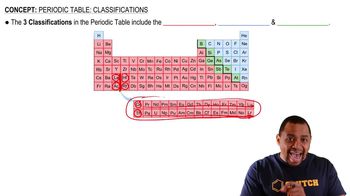
Elements are classified into metals, nonmetals, and metalloids based on their properties and positions in the periodic table. Metals, typically found on the left side, are good conductors of heat and electricity, while nonmetals, located on the right, are poor conductors and often have more varied properties. Metalloids, found along the zig-zag line, exhibit characteristics of both metals and nonmetals.
Recommended video:
Guided course
Periodic Table Classifications
Element Symbols
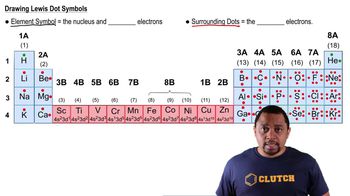
Each chemical element is represented by a unique one- or two-letter symbol, derived from its English or Latin name. For example, gold is represented as 'Au' from its Latin name 'Aurum', while sodium is 'Na' from 'Natrium'. Understanding these symbols is essential for identifying elements in chemical equations and reactions.
Recommended video:
Guided course
Lewis Dot Symbols
Properties of Elements
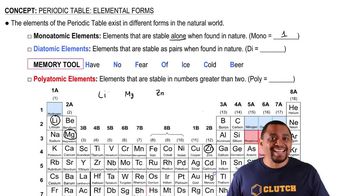
The classification of elements as metals, nonmetals, or metalloids is based on their physical and chemical properties. Metals are typically shiny, malleable, and ductile, while nonmetals are often dull and brittle. Metalloids possess intermediate properties, making them useful in various applications, such as semiconductors in electronics.
Recommended video:
Guided course
Elemental Forms of Elements
Related Practice
Textbook Question
617
views
Textbook Question
Fill in the blanks to complete the table. Symbol Ion Formed Number of Electrons in Ion Number of Protons in Ion Ca Ca2+ ______ ______ ______ Be2+ 2 ______ Se ______ ______ 34 In ______ ______ 49
Textbook Question
Fill in the blanks to complete the table.
Symbol Ion Formed Number of Electrons in Ion Number of Protons in Ion
Cl ______ ______ 17
Te ______ 54 ______
Br Br– ______ ______
______ Sr2+ ______ 38
1178
views
1
rank
Textbook Question
Which pair of elements do you expect to be most similar? Why? a. N and Ni b. Mo and Sn c. Na and Mg d. Cl and F e. Si and P
Textbook Question
Classify each element as an alkali metal, alkaline earth metal, halogen, or noble gas. a. sodium b. iodine c. calcium d. barium e. krypton