Ch.2 - Atoms & Elements
Tro - Chemistry: A Molecular Approach 4th Edition
Tro4th EditionChemistry: A Molecular ApproachISBN: 9780134112831Not the one you use?Change textbook
Chapter 2, Problem 45b

On a dry day, your body can accumulate static charge from walking across a carpet or from brushing your hair. If your body develops a charge of -15 µC (microcoulombs), what is their collective mass?

Verified step by step guidance
1
Identify the charge given in the problem, which is -15 mC (microcoulombs). Note that 1 microcoulomb (mC) equals \(1 imes 10^{-6}\) coulombs (C).
Recognize that the charge carriers in the human body are primarily electrons. The charge of one electron is approximately \(-1.602 imes 10^{-19}\) coulombs.
Calculate the number of electrons corresponding to a total charge of -15 mC. Use the formula: Number of electrons = Total charge / Charge of one electron.
Determine the mass of one electron, which is approximately \(9.109 imes 10^{-31}\) kilograms.
Calculate the total mass of the electrons by multiplying the number of electrons by the mass of one electron.

Verified video answer for a similar problem:

This video solution was recommended by our tutors as helpful for the problem above.
Video duration:
3m
Was this helpful?

Key Concepts

Here are the essential concepts you must grasp in order to answer the question correctly.

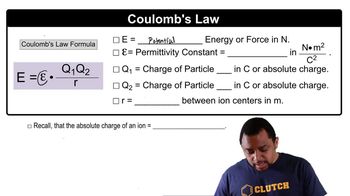
Coulomb's Law

Coulomb's Law describes the electrostatic force between charged objects. It states that the force is directly proportional to the product of the charges and inversely proportional to the square of the distance between them. This principle is fundamental in understanding how static charges interact, which is relevant when considering the accumulation of charge on the body.
Recommended video:
Guided course
01:15
Coulomb's Law Concept 2

Charge and Mass Relationship

The relationship between charge and mass can be explored through the concept of charge-to-mass ratio. While charge itself does not have mass, the energy associated with a charge can be related to mass via Einstein's equation, E=mc². This concept is crucial for calculating the effective mass of a charged object based on its electric potential energy.
Recommended video:
Guided course
01:53
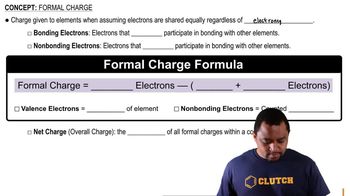
Formal Charge

Microcoulombs to Mass Conversion

To find the mass associated with a given charge, one can use the energy stored in the electric field created by the charge. The conversion involves calculating the energy using the charge and potential difference, then applying the mass-energy equivalence principle. This process allows for the determination of the mass equivalent of the static charge accumulated on the body.
Related Practice
Textbook Question

How many electrons are necessary to produce a charge of -1.0 C? What is the mass of this many electrons?

1766
views
2
rank
3
comments

Textbook Question

Which statements about subatomic particles are true? a. If an atom has an equal number of protons and electrons, it will be charge-neutral. b. Electrons are attracted to protons. c. Electrons are much lighter than neutrons. d. Protons have twice the mass of neutrons.

3004
views
1
rank
Textbook Question

Which statements are inconsistent with Rutherford's nuclear theory as it was originally stated? Why? a. Since electrons are smaller than protons, and since a hydrogen atom contains only one proton and one electron, it must follow that the volume of a hydrogen atom is mostly due to the proton. b. A nitrogen atom has 7 protons in its nucleus and 7 electrons outside of its nucleus. c. A phosphorus atom has 15 protons in its nucleus and 150 electrons outside of its nucleus. d. The majority of the mass of a fluorine atom is due to its 9 electrons.

1626
views
1
comments
Textbook Question

Which statements are inconsistent with Dalton's atomic theory as it was originally stated? Why? a. All carbon atoms are identical. b. An oxygen atom combines with 1.5 hydrogen atoms to form a water molecule. c. Two oxygen atoms combine with a carbon atom to form a carbon dioxide molecule. d. The formation of a compound often involves the destruction of one or more atoms.

1719
views
Textbook Question

Which statements about subatomic particles are false? a. Protons and electrons have charges of the same magnitude but opposite sign. b. Protons have about the same mass as neutrons. c. Some atoms don't have any protons. d. Protons and neutrons have charges of the same magnitude but opposite signs.

2256
views
1
rank
1
comments
Textbook Question

On a dry day, your body can accumulate static charge from walking across a carpet or from brushing your hair. If your body develops a charge of -15 µC (microcoulombs), how many excess electrons has it acquired?

749
views