
Textbook Question
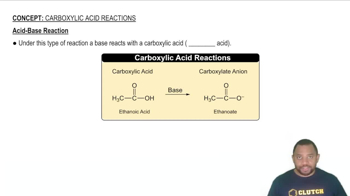
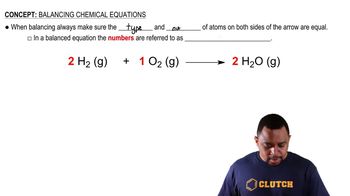
Write balanced complete ionic and net ionic equations for each acid–base reaction. a. HI(aq) + RbOH(aq) →
1345
views

 Verified step by step guidance
 01:09
01:09
 01:32
01:32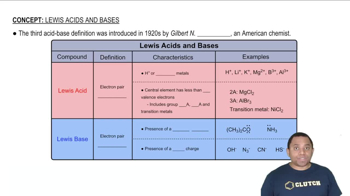 05:04
05:04Write balanced complete ionic and net ionic equations for each acid–base reaction. a. HI(aq) + RbOH(aq) →
Complete and balance each acid–base equation.
a. H2SO4(aq) + Ca(OH)2(aq) →
b. HClO4(aq) + KOH(aq) →
c. H2SO4(aq) + NaOH(aq) →
Lead(II) ions can be removed from solution by precipitation with sulfate ions. Suppose that a solution contains lead(II) nitrate. Write complete ionic and net ionic equations for the reaction of aqueous lead(II) nitrate with aqueous potassium sulfate to form solid lead(II) sulfate and aqueous potassium nitrate.
Write balanced molecular and net ionic equations for the reaction between nitric acid and calcium hydroxide.
Write balanced complete ionic and net ionic equations for each acid–base reaction. a. HBr(aq) + NaOH(aq) → b. HF(aq) + NaOH(aq) → c. HC2H3O2(aq) + RbOH(aq) →
Write balanced complete ionic and net ionic equations for each acid–base reaction.
b. HCHO2(aq) + NaOH(aq) →
c. HC2H3O2(aq) + LiOH(aq) →