
Textbook Question
Calculate the theoretical yield of the product (in moles) for each initial amount of reactants.
Ti(s) + 2 Cl2(g) → TiCl4(s)
a. 4 mol Ti, 4 mol Cl2
b. 7 mol Ti, 17 mol Cl2
c. 12.4 mol Ti, 18.8 mol Cl2
1693
views

 Verified step by step guidance
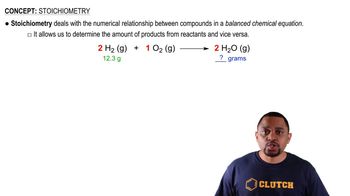
 01:16
01:16
 01:30
01:30 02:14
02:14Calculate the theoretical yield of the product (in moles) for each initial amount of reactants.
Ti(s) + 2 Cl2(g) → TiCl4(s)
a. 4 mol Ti, 4 mol Cl2
b. 7 mol Ti, 17 mol Cl2
c. 12.4 mol Ti, 18.8 mol Cl2
Calculate the theoretical yield of product (in moles) for each initial amount of reactants.
3 Mn(s) + 2 O2(g) → Mn3O4(s)
a. 3 mol Mn, 2 mol O2
b. 4 mol Mn, 7 mol O2
c. 27.5 mol Mn, 43.8 mol O2
Zinc sulfide reacts with oxygen according to the reaction: 2 ZnS(s) + 3 O2(g) → 2 ZnO(s) + 2 SO2( g) A reaction mixture initially contains 4.2 mol ZnS and 6.8 mol O2. Once the reaction has occurred as completely as possible, what amount (in moles) of the excess reactant remains?
Find the limiting reactant for each initial amount of reactants. 4 Al(s) + 3 O2( g) → 2 Al2O3(s)
a. 1 mol Al, 1 mol O2
b. 4 mol Al, 2.6 mol O2
c. 16 mol Al, 13 mol O2
d. 7.4 mol Al, 6.5 mol O2
Find the limiting reactant for each initial amount of reactants.
2 Na(s) + Br2(g) → 2 NaBr(s)
a. 2 mol Na, 2 mol Br2
b. 1.8 mol Na, 1.4 Br2
c. 2.5 mol Na, 1 mol Br2
d. 12.6 mol Na, 6.9 mol Br2