Use the molar volume of a gas at STP to calculate the density (in g/L) of nitrogen gas at STP.
Ch.5 - Gases
Chapter 5, Problem 57
A 248-mL gas sample has a mass of 0.433 g at a pressure of 745 mmHg and a temperature of 28 °C. What is the molar mass of the gas?
Verified step by step guidance1
Convert the temperature from Celsius to Kelvin by adding 273.15 to the Celsius temperature.
Convert the pressure from mmHg to atm using the conversion factor: 1 atm = 760 mmHg.
Use the Ideal Gas Law equation, PV = nRT, to solve for the number of moles (n) of the gas. Remember to convert the volume from mL to L by dividing by 1000.
Calculate the molar mass of the gas by dividing the mass of the gas sample by the number of moles calculated in the previous step.
Ensure all units are consistent and check calculations for accuracy.

Verified video answer for a similar problem:
This video solution was recommended by our tutors as helpful for the problem above.
Video duration:
6mWas this helpful?
Key Concepts
Here are the essential concepts you must grasp in order to answer the question correctly.
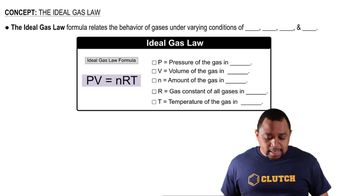
Ideal Gas Law
The Ideal Gas Law relates the pressure, volume, temperature, and number of moles of a gas through the equation PV = nRT. Here, P is pressure, V is volume, n is the number of moles, R is the ideal gas constant, and T is temperature in Kelvin. This law is fundamental for calculating properties of gases under various conditions.
Recommended video:
Guided course
Ideal Gas Law Formula
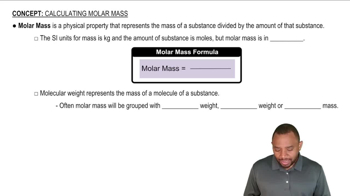
Molar Mass
Molar mass is defined as the mass of one mole of a substance, typically expressed in grams per mole (g/mol). It can be calculated by dividing the mass of the gas sample by the number of moles present. Understanding molar mass is crucial for converting between mass and moles in chemical calculations.
Recommended video:
Guided course
Molar Mass Concept
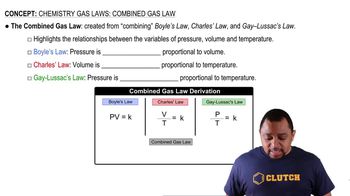
Gas Laws and Conditions
Gas laws describe the behavior of gases under different conditions of pressure, volume, and temperature. In this problem, the gas sample's conditions (pressure in mmHg and temperature in Celsius) must be converted to appropriate units (atmospheres and Kelvin) to apply the Ideal Gas Law correctly. Familiarity with these conversions is essential for accurate calculations.
Recommended video:
Guided course
Combined Gas Law
Related Practice
Textbook Question
3002
views
1
rank
Textbook Question
A sample of N2O gas has a density of 2.85 g/L at 298 K. What is the pressure of the gas (in mmHg)?
2576
views
Textbook Question
A sample of gas has a mass of 38.8 mg. Its volume is 224 mL at a temperature of 55 °C and a pressure of 886 torr. Find the molar mass of the gas.
2066
views
1
rank
Textbook Question
What is the density (in g/L) of hydrogen gas at 20.0 °C and a pressure of 1655 psi?
3602
views
1
rank
Textbook Question
A sample of gas has a mass of 0.555 g. Its volume is 117 mL at a temperature of 85 °C and a pressure of 753 mmHg. Find the molar mass of the gas.
1825
views
1
comments
Textbook Question
A gas mixture contains each of the following gases at the indicated partial pressures: N2, 215 torr; O2, 102 torr; and He, 117 torr. What is the total pressure of the mixture? What mass of each gas is present in a 1.35-L sample of this mixture at 25.0 °C?
3669
views