A mixture of 8.0 g CH4 and 8.0 g Xe is placed in a container and the total pressure is found to be 0.44 atm. Determine the partial pressure of CH4.
Ch.5 - Gases
Chapter 5, Problem 124
Binary compounds of alkali metals and hydrogen react with water to liberate H2(g). The H2 from the reaction of a sample of NaH with an excess of water fills a volume of 0.490 L above the water. The temperature of the gas is 35 °C and the total pressure is 758 mmHg. Determine the mass of H2 liberated and the mass of NaH that reacted.
Verified step by step guidance1
Convert the temperature from Celsius to Kelvin by adding 273.15 to the given temperature (35 °C).
Use the ideal gas law equation, \( PV = nRT \), to calculate the number of moles of \( H_2 \) gas. Here, \( P \) is the pressure in atm, \( V \) is the volume in liters, \( n \) is the number of moles, \( R \) is the ideal gas constant (0.0821 L·atm/mol·K), and \( T \) is the temperature in Kelvin.
Convert the total pressure from mmHg to atm by dividing by 760.
Calculate the mass of \( H_2 \) using the number of moles obtained from the ideal gas law and the molar mass of \( H_2 \) (2.02 g/mol).
Use the stoichiometry of the reaction \( \text{NaH} + \text{H}_2\text{O} \rightarrow \text{NaOH} + \text{H}_2 \) to determine the mass of \( \text{NaH} \) that reacted, knowing that 1 mole of \( \text{NaH} \) produces 1 mole of \( \text{H}_2 \). Calculate the mass of \( \text{NaH} \) using its molar mass (23.99 g/mol).

Verified video answer for a similar problem:
This video solution was recommended by our tutors as helpful for the problem above.
Video duration:
5mWas this helpful?
Key Concepts
Here are the essential concepts you must grasp in order to answer the question correctly.
Gas Laws
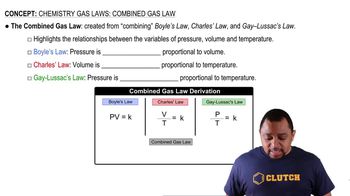
Gas laws describe the behavior of gases in relation to pressure, volume, and temperature. The Ideal Gas Law (PV=nRT) is particularly relevant here, as it allows us to calculate the number of moles of hydrogen gas (H2) produced from the given volume, temperature, and pressure. Understanding these relationships is crucial for determining the amount of gas liberated in the reaction.
Recommended video:
Guided course
Combined Gas Law
Stoichiometry
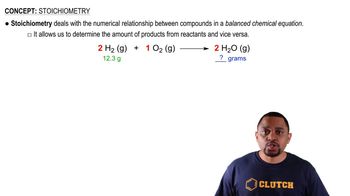
Stoichiometry involves the calculation of reactants and products in chemical reactions based on balanced equations. In this case, knowing the stoichiometric relationship between sodium hydride (NaH) and hydrogen gas (H2) is essential to determine how much NaH reacted to produce the measured volume of H2. This concept is fundamental for quantifying the amounts of substances involved in chemical reactions.
Recommended video:
Guided course
Stoichiometry Concept
Molar Mass
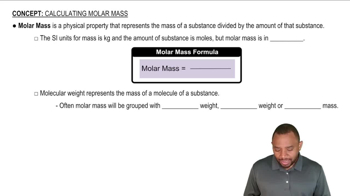
Molar mass is the mass of one mole of a substance, typically expressed in grams per mole (g/mol). To find the mass of H2 liberated and the mass of NaH that reacted, we need to use the molar mass of hydrogen (approximately 2.02 g/mol) and sodium hydride (approximately 24.99 g/mol). This concept is vital for converting moles of gas into grams, allowing for the calculation of the mass of reactants and products.
Recommended video:
Guided course
Molar Mass Concept
Related Practice
Textbook Question
1042
views
1
rank
Textbook Question
A mixture of CO(g) and O2(g) in a 1.0-L container at 1.0×10³ K has a total pressure of 2.2 atm. After some time, the total pressure falls to 1.9 atm as the result of the formation of CO2. Determine the mass (in grams) of CO2 that forms.
1477
views
Textbook Question
In a given diffusion apparatus, 15.0 mL of HBr gas diffuses in 1.0 min. In the same apparatus and under the same conditions, 20.3 mL of an unknown gas diffuses in 1.0 min. The unknown gas is a hydrocarbon. Find its molecular formula.
2094
views
Textbook Question
A sample of N2O3(g) has a pressure of 0.017 atm. The temperature (in K) is doubled and the N2O3 undergoes complete decomposition to NO2(g) and NO(g). Find the total pressure of the mixture of gases assuming constant volume and no additional temperature change.
1332
views