Write an equation for the formation of each compound from its elements in their standard states, and find ΔH°rxn for each in Appendix IIB. d. CH3OH(l)
Ch.6 - Thermochemistry
Chapter 6, Problem 81
Calculate ΔHrxn for the reaction:
5 C(s) + 6 H2(g) → C5H12(l)
Use the following reactions and given ΔH's:
C5H12(l) + 8 O2(g) → 5 CO2(g) + 6 H2O(g) ΔH = –3244.8 kJ
C(s) + O2(g) → CO2(g) ΔH = –393.5 kJ
2 H2(g) + O2(g) → 2 H2O(g) ΔH = –483.5 kJ
Verified step by step guidance1
Identify the target reaction and the given reactions. The target reaction is: 5 C(s) + 6 H2(g) → C5H12(l). The given reactions are: (1) C5H12(l) + 8 O2(g) → 5 CO2(g) + 6 H2O(g), (2) C(s) + O2(g) → CO2(g), and (3) 2 H2(g) + O2(g) → 2 H2O(g).
Write the enthalpy changes for the given reactions: ΔH1 = -3244.8 kJ for the first reaction, ΔH2 = -393.5 kJ for the second reaction, and ΔH3 = -483.5 kJ for the third reaction.
Reverse the first given reaction to match the products and reactants of the target reaction. The reversed reaction will be: 5 CO2(g) + 6 H2O(g) → C5H12(l) + 8 O2(g) and the enthalpy change for this reaction will be the opposite of ΔH1, i.e., ΔH1' = +3244.8 kJ.
Adjust the coefficients of the second and third given reactions to match the coefficients in the target reaction. Multiply the second reaction by 5 and the third reaction by 3. The adjusted reactions are: 5 C(s) + 5 O2(g) → 5 CO2(g) and 6 H2(g) + 3 O2(g) → 6 H2O(g) with enthalpy changes ΔH2' = 5 * (-393.5 kJ) and ΔH3' = 3 * (-483.5 kJ).
Add the reversed first reaction and the adjusted second and third reactions to obtain the target reaction. Sum the enthalpy changes of these reactions to find ΔHrxn for the target reaction: ΔHrxn = ΔH1' + ΔH2' + ΔH3'.

Verified video answer for a similar problem:
This video solution was recommended by our tutors as helpful for the problem above.
Video duration:
3mWas this helpful?
Key Concepts
Here are the essential concepts you must grasp in order to answer the question correctly.
Hess's Law
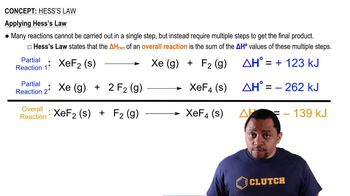
Hess's Law states that the total enthalpy change for a reaction is the sum of the enthalpy changes for the individual steps of the reaction, regardless of the pathway taken. This principle allows us to calculate the enthalpy change (ΔHrxn) for a reaction by using known ΔH values from related reactions, making it essential for solving problems involving thermochemical equations.
Recommended video:
Guided course
Hess's Law
Standard Enthalpy of Formation
The standard enthalpy of formation (ΔHf°) is the change in enthalpy when one mole of a compound is formed from its elements in their standard states. This concept is crucial for calculating ΔHrxn, as it provides a reference point for the energy changes associated with the formation of reactants and products in a chemical reaction.
Stoichiometry in Thermochemistry
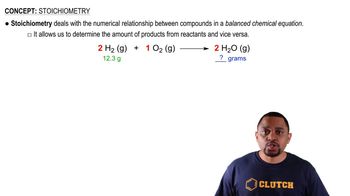
Stoichiometry in thermochemistry involves using the coefficients from a balanced chemical equation to relate the amounts of reactants and products to their respective enthalpy changes. Understanding stoichiometry is vital for accurately calculating ΔHrxn, as it ensures that the enthalpy changes are applied in proportion to the quantities of substances involved in the reaction.
Recommended video:
Guided course
Stoichiometry Concept
Related Practice
Textbook Question
435
views
Textbook Question
Write an equation for the formation of each compound from its elements in their standard states, and find ΔH°rxn for each in Appendix IIB. b. MgCO3(s)
1906
views
Textbook Question
Calculate ΔHrxn for the reaction:
Fe2O3(s) + 3 CO(g) → 2 Fe(s) + 3 CO2(g)
Use the following reactions and given ΔH's:
2 Fe(s) + 3/2 O2(g) → Fe2O3(s) ΔH = –824.2 kJ
CO(g) + 1/2 O2(g) → CO2(g) ΔH = –282.7 kJ
2714
views
Textbook Question
Consider the generic reaction:
A + 2 B → C + 3 D ΔH = 155 kJ
Determine the value of ΔH for each related reaction.
a. 3 A + 6 B → 3 C + 9 D
b. C + 3 D → A + 2 B
c. 1/2 C + 3/2 D → 1/2 A + B
1781
views
Textbook Question
For each generic reaction, determine the value of ΔH2 in terms of ΔH1.
c. A → B + 2 C ΔH1
1/2 B + C → 1/2 A ΔH2 = ?
373
views