
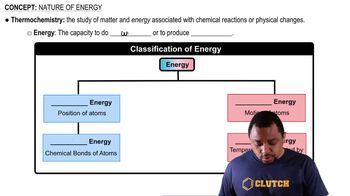
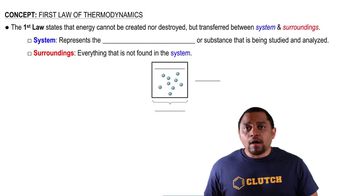
Identify each energy exchange as primarily heat or work and determine whether the sign of ΔE is positive or negative for the system. Identify each energy exchange as primarily heat or work. a. A rolling billiard ball collides with another billiard ball. The first billiard ball (defined as the system) stops rolling after the collision. b. A book falls to the floor. (The book is the system). c. A father pushes his daughter on a swing. (The daughter and the swing are the system). Identify each energy exchange as primarily heat or work.
During an energy exchange, a chemical system absorbs energy from its surroundings. What is the sign of ΔEsys for this process?
Verified step by step guidanceKey Concepts
Energy Exchange
Internal Energy (ΔEsys)
Sign Convention in Thermodynamics
Identify each energy exchange as primarily heat or work and determine whether the sign of ΔE is positive or negative for the system. a. Sweat evaporates from skin, cooling the skin. (The evaporating sweat is the system.)
Identify each energy exchange as primarily heat or work and determine whether the sign of ΔE is positive or negative for the system. a. Sweat evaporates from skin, cooling the skin. (The evaporating sweat is the system.) b. A balloon expands against an external pressure. (The contents of the balloon is the system.) c. An aqueous chemical reaction mixture is warmed with an external flame. (The reaction mixture is the system.) Identify energy exchanges as primarily heat or work. Determine whether the sign of E is positive or negative for the system.
Suppose that a person eats 2387 Calories per day. Convert this amount of energy into each unit. a. J b. kJ c. kWh
A particular frost-free refrigerator uses about 745 kWh of electrical energy per year. Express this amount of energy in each unit. c. Cal
