
Top fuel dragsters and funny cars burn nitromethane as fuel according to the balanced combustion equation: 2 CH3NO2(l) + 3/2O2(g) → 2 CO2(g) + 3 H2O(l) + N2(g) ΔH°rxn = –1418 kJ The enthalpy of combustion for nitromethane is –709.2 kJ/mol. Calculate the standard enthalpy of formation (ΔH°f ) for nitromethane.
Ch.6 - Thermochemistry
Chapter 6, Problem 88d
Use standard enthalpies of formation to calculate ΔH°rxn for each reaction. d. N2O4(g) + 4 H2(g) → N2(g) + 4 H2O(g)
Verified step by step guidance1
Identify the standard enthalpy of formation (ΔH°f) for each reactant and product in the reaction. These values are typically found in tables in chemistry textbooks or reliable online resources.
Write the balanced chemical equation: N₂O₄(g) + 4 H₂(g) → N₂(g) + 4 H₂O(g).
Apply the formula for the standard enthalpy change of the reaction: ΔH°rxn = Σ(ΔH°f of products) - Σ(ΔH°f of reactants).
Calculate the sum of the standard enthalpies of formation for the products: [ΔH°f(N₂(g)) + 4 * ΔH°f(H₂O(g))].
Calculate the sum of the standard enthalpies of formation for the reactants: [ΔH°f(N₂O₄(g)) + 4 * ΔH°f(H₂(g))]. Subtract the sum of the reactants from the sum of the products to find ΔH°rxn.

Verified video answer for a similar problem:
This video solution was recommended by our tutors as helpful for the problem above.
Video duration:
2mWas this helpful?
Key Concepts
Here are the essential concepts you must grasp in order to answer the question correctly.
Enthalpy of Formation
The standard enthalpy of formation (ΔH°f) is the change in enthalpy when one mole of a compound is formed from its elements in their standard states. It is a crucial value used in thermodynamics to calculate the heat changes in chemical reactions. Each substance has a specific ΔH°f, which can be found in tables, and is essential for determining the overall enthalpy change of a reaction.
Hess's Law
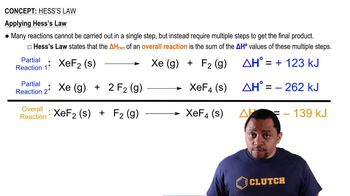
Hess's Law states that the total enthalpy change for a reaction is the same, regardless of the number of steps taken to achieve the reaction. This principle allows chemists to calculate the enthalpy change of a reaction by summing the enthalpy changes of individual steps, making it possible to use standard enthalpies of formation to find ΔH°rxn for complex reactions.
Recommended video:
Guided course
Hess's Law
Reaction Enthalpy Change (ΔH°rxn)
The reaction enthalpy change (ΔH°rxn) is the difference between the total enthalpy of the products and the total enthalpy of the reactants. It indicates whether a reaction is exothermic (releases heat, ΔH°rxn < 0) or endothermic (absorbs heat, ΔH°rxn > 0). Calculating ΔH°rxn using standard enthalpies of formation involves subtracting the sum of the ΔH°f values of the reactants from that of the products.
Related Practice
Textbook Question
3123
views
3
comments
Textbook Question
Ethanol (C2H5OH) can be made from the fermentation of crops and has been used as a fuel additive to gasoline. Write a balanced equation for the combustion of ethanol and calculate ΔH°rxn.
1712
views
Textbook Question
Use standard enthalpies of formation to calculate ΔH°rxn for each reaction. a. 2 H2S(g) + 3 O2(g) → 2 H2O(l) + 2 SO2(g)
396
views
Textbook Question
Use standard enthalpies of formation to calculate ΔH°rxn for each reaction. b. SO2(g) + 1/2 O2(g) → SO3(g)
1904
views
Textbook Question
During photosynthesis, plants use energy from sunlight to form glucose (C6H12O6) and oxygen from carbon dioxide and water. Write a balanced equation for photosynthesis.
2183
views
