
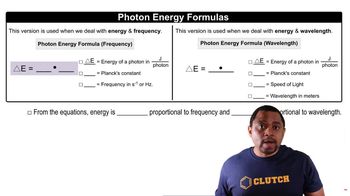

An X-ray photon of wavelength 0.989 nm strikes a surface. The emitted electron has a kinetic energy of 969 eV. What is the binding energy of the electron in kJ/mol? [KE = 1/2 mv2; 1 electron volt (eV) = 1.602×10⁻¹⁹ J]
An argon ion laser puts out 5.0 W of continuous power at a wavelength of 532 nm. The diameter of the laser beam is 5.5 mm. If the laser is pointed toward a pinhole with a diameter of 1.2 mm, how many photons travel through the pinhole per second? Assume that the light intensity is equally distributed throughout the entire cross-sectional area of the beam. (1 W = 1 J/s)
Verified step by step guidance
Verified video answer for a similar problem:
Key Concepts
Photon Energy
Laser Beam Intensity
Photon Flux
The human eye contains a molecule called 11-cis-retinal that changes shape when struck with light of sufficient energy. The change in shape triggers a series of events that results in an electrical signal being sent to the brain that results in vision. The minimum energy required to change the conformation of 11-cis-retinal within the eye is about 164 kJ/mol. Calculate the longest wavelength visible to the human eye.
An electron in the n = 7 level of the hydrogen atom relaxes to a lower-energy level, emitting light of 397 nm. What is the value of n for the level to which the electron relaxed?
Calculate the frequency of the light emitted when an electron in a hydrogen atom makes each transition: a. n = 4 → n = 3 b. n = 5 → n = 1 c. n = 5 → n = 4 d. n = 6 → n = 5
