Pearson+ LogoPearson+ Logo
Ch. 8 - Genetic Analysis and Mapping in Bacteria and Bacteriophages
Klug - Essentials of Genetics 10th Edition
Klug10th EditionEssentials of GeneticsISBN: 9780135588789Not the one you use?Change textbook
Chapter 8, Problem 15

Describe the difference between the lytic cycle and lysogeny when bacteriophage infection occurs.

Verified step by step guidance
1
Start by defining what a bacteriophage is: a virus that infects bacteria and can follow different life cycles once inside the host.
Explain the lytic cycle: the bacteriophage injects its DNA into the host, takes over the host's machinery to produce new phage particles, and eventually causes the bacterial cell to lyse (burst), releasing new viruses.
Describe lysogeny: instead of immediately producing new viruses, the phage DNA integrates into the bacterial chromosome and replicates along with it without killing the host, existing in a dormant state called a prophage.
Highlight the key difference: the lytic cycle results in immediate destruction of the host cell and production of new viruses, while lysogeny allows the phage DNA to persist in the host without causing harm until certain conditions trigger the lytic cycle.
Mention that lysogeny can switch to the lytic cycle under stress or environmental changes, leading to active virus production and cell lysis.

Key Concepts

Here are the essential concepts you must grasp in order to answer the question correctly.

Lytic Cycle

The lytic cycle is a viral replication process where a bacteriophage infects a host cell, takes over its machinery to produce new phage particles, and ultimately causes the host cell to lyse (burst), releasing new viruses to infect other cells.
Recommended video:
Guided course
08:04
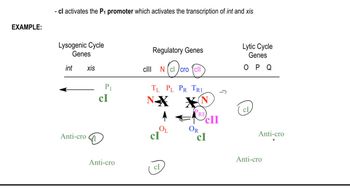
Decision Between Lytic and Lysogenic Cycles

Lysogeny

Lysogeny is a viral life cycle in which the bacteriophage integrates its genome into the host bacterium's chromosome, becoming a prophage. The viral DNA replicates passively with the host without killing it, allowing the virus to remain dormant until triggered to enter the lytic cycle.
Recommended video:
Guided course
08:04
Decision Between Lytic and Lysogenic Cycles

Differences Between Lytic and Lysogenic Cycles

The key difference is that the lytic cycle results in immediate production of new viruses and destruction of the host cell, while lysogeny involves viral DNA integration and dormancy without host death. Lysogeny can switch to the lytic cycle under certain conditions, making it a latent infection.
Recommended video:
Guided course
08:04
Decision Between Lytic and Lysogenic Cycles