Ch. 17 - Recombinant DNA Technology

Klug10th EditionEssentials of GeneticsISBN: 9780135588789
Not the one you use?Change textbookSelect a different textbook
Table of contents
- Ch. 1 - Introduction to Genetics16
- Ch. 2 - Mitosis and Meiosis28
- Ch. 3 - Mendelian Genetics37
- Ch. 4 - Modification of Mendelian Ratios53
- Ch. 5 - Sex Determination and Sex Chromosomes32
- Ch. 6 - Chromosome Mutations: Variation in Number and Arrangement37
- Ch. 7 - Linkage and Chromosome Mapping in Eukaryotes36
- Ch. 8 - Genetic Analysis and Mapping in Bacteria and Bacteriophages24
- Ch. 9 - DNA Structure and Analysis38
- Ch. 10 - DNA Replication29
- Ch. 11 - Chromosome Structure and DNA Sequence Organization22
- Ch. 12 - The Genetic Code and Transcription36
- Ch. 13 - Translation and Proteins27
- Ch. 14 - Gene Mutation, DNA Repair, and Transposition34
- Ch. 15 - Regulation of Gene Expression in Bacteria22
- Ch. 16 - Regulation of Gene Expression in Eukaryotes37
- Ch. 17 - Recombinant DNA Technology27
- Ch. 18 - Genomics, Bioinformatics, and Proteomics30
- Ch. 19 - The Genetics of Cancer21
- Ch. 20 - Quantitative Genetics and Multifactorial Traits37
- Ch. 21 - Population and Evolutionary Genetics45

Chapter 17, Problem 26
Provide one example of a CRISPR-Cas application for biotechnology.
 Verified step by step guidance
1
Understand that CRISPR-Cas is a powerful genome editing tool that allows precise modification of DNA sequences in living organisms.
Identify a key application of CRISPR-Cas in biotechnology, such as gene editing to improve crop traits, develop disease-resistant plants, or create genetically modified organisms (GMOs).
Consider an example like using CRISPR-Cas to knock out a gene responsible for susceptibility to a plant disease, thereby enhancing the plant's resistance.
Explain how the CRISPR-Cas system targets a specific DNA sequence using a guide RNA and introduces a cut, which the cell repairs, leading to the desired genetic change.
Summarize the application by highlighting its impact, such as increased crop yield, reduced pesticide use, or improved nutritional content.
Key Concepts
Here are the essential concepts you must grasp in order to answer the question correctly.
CRISPR-Cas System
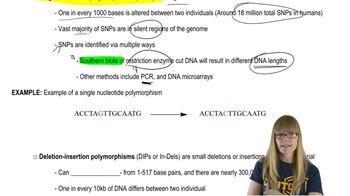
The CRISPR-Cas system is a natural adaptive immune mechanism found in bacteria that can be engineered to target and edit specific DNA sequences. It uses a guide RNA to direct the Cas nuclease to a complementary DNA sequence, enabling precise gene editing.
Recommended video:
Guided course
 09:28
09:28
Genomic Variation
Gene Editing in Biotechnology
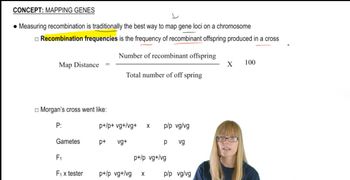
Gene editing involves making targeted changes to an organism's DNA to alter its traits. In biotechnology, this allows for the development of genetically modified organisms with improved characteristics, such as disease resistance or enhanced productivity.
Recommended video:
Guided course
 09:09
09:09Mapping Genes
Applications of CRISPR-Cas
CRISPR-Cas technology is applied in biotechnology for purposes like creating disease-resistant crops, developing gene therapies for genetic disorders, and engineering microbes for biofuel production. These applications demonstrate its versatility and impact.
Recommended video:
Guided course
09:28Genomic Variation
Related Practice