What structure protects the DNA of a bacteriophage virus?
The protein coat, known as the capsid, protects the DNA of a bacteriophage virus.
Can bacteriophages use RNA as their genome, and if so, how does this relate to their classification?
Yes, some bacteriophages can use RNA as their genome. Viruses, including certain bacteriophages, may have either DNA or RNA as their genetic material.
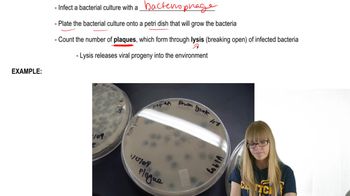
What laboratory technique is commonly used to quantify bacteriophage infection in bacteria?
The plaque assay is used to quantify bacteriophage infection by counting plaques formed on a bacterial plate. Each plaque represents an area where bacteria have been lysed by the virus.
How do virulent phages differ from temperate phages in their life cycle?
Virulent phages immediately lyse and kill the host cell after infection. Temperate phages can remain dormant inside the host for extended periods before eventually lysing the cell.
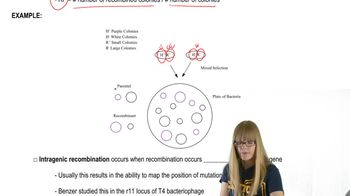
What is a mixed infection in the context of bacteriophage genetics?
A mixed infection involves infecting a bacterial culture with two different strains of bacteriophages. This allows for the study of recombination between phage genomes.
How is recombination frequency used to map bacteriophage genes?
Recombination frequency is calculated by dividing the number of recombinant colonies by the total number of colonies. Lower recombination frequencies indicate genes are closer together on the genome.
What does a recombination frequency of 50% between two bacteriophage genes suggest?
A 50% recombination frequency suggests that the genes are very far apart on the genome. This is because recombination occurs frequently between distant genes.
What is entrogenic recombination and why is it significant in bacteriophage genetics?
Entrogenic recombination refers to recombination events occurring within a single gene. This allows for precise mapping of mutations inside a gene, which is unique to bacteriophages.
Who conducted extensive studies on the r11 locus of the T4 bacteriophage and what was achieved?
Fenzer studied over 20,000 mutants of the r11 locus in the T4 bacteriophage. He mapped the relative positions of mutations within the gene using recombination frequencies.
Why was Fenzer's mapping of mutations within a gene considered novel at the time?
Fenzer's work was novel because it was the first time mutations within a gene were mapped using recombination frequencies. This provided a new level of detail in genetic mapping before DNA sequencing was available.
 Back
Back
 06:04
06:04