Which type of chromosomal mutation involves the exchange or movement of segments between two different chromosomes?
Translocations are chromosomal mutations that involve the movement of chromosomal segments to different chromosomes. This can occur as reciprocal translocations, where two chromosomes exchange segments, or as Robertsonian translocations, where the long arms of two non-homologous acrocentric chromosomes fuse together.
What is a reciprocal translocation in genetics, and how does it involve two chromosomes?
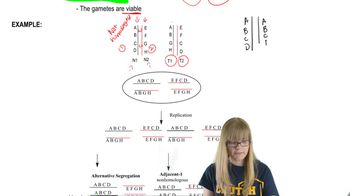
A reciprocal translocation is a type of chromosomal rearrangement in which two different chromosomes exchange acentric fragments (segments without centromeres). This results in each chromosome carrying genetic material from the other, and involves two chromosomes directly.
Describe a Robertsonian translocation and explain how it involves two chromosomes.
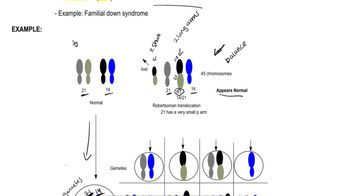
A Robertsonian translocation occurs when the short arms of two non-homologous acrocentric chromosomes break off and the long arms fuse to form a single chromosome. This rearrangement involves two chromosomes and can lead to genetic conditions such as familial Down syndrome.
What are the three types of gamete segregation that can occur after a reciprocal translocation during meiosis?
The three types are adjacent-1 segregation, adjacent-2 segregation, and alternative segregation. Only alternative segregation produces viable gametes with a complete set of genetic information.
Why are gametes resulting from adjacent-1 and adjacent-2 segregation in reciprocal translocations typically non-viable?
They are non-viable because they lack a complete set of chromosomes or genetic information. This incomplete set prevents proper development after fertilization.
How does the pairing of homologous chromosomes during metaphase differ after a reciprocal translocation compared to normal meiosis?
After a reciprocal translocation, there are more possible pairings because chromosomes now have both normal and translocated segments. This increases the complexity of chromosome alignment during metaphase.
What is the genetic consequence of a balanced Robertsonian translocation in a carrier parent?
A balanced Robertsonian translocation carrier has all necessary genetic material but arranged abnormally, resulting in no phenotypic effect. The carrier has 45 chromosomes due to the loss of small acrocentric arms.
How does a Robertsonian translocation lead to familial Down syndrome in offspring?
If a gamete from a carrier parent contains both a normal chromosome 21 and a Robertsonian translocation chromosome with an extra 21, the resulting zygote will have three copies of chromosome 21. This causes trisomy 21, or Down syndrome.
Why do individuals with a balanced Robertsonian translocation have 45 chromosomes instead of 46?
They have 45 chromosomes because the two short arms of the involved acrocentric chromosomes are lost during the translocation. These short arms contain little unique genetic material, so their loss does not cause a phenotype.
What percentage of Down syndrome cases are caused by familial Robertsonian translocations, and why is this significant?
About 5% of Down syndrome cases are due to familial Robertsonian translocations. This is significant because it highlights a rare but important inherited mechanism for trisomy 21.