Skip to main content
Genetics
My Course
Learn
Exam Prep
AI Tutor
Study Guides
Textbook Solutions
Flashcards
Explore
Try the app
My Course
Learn
Exam Prep
AI Tutor
Study Guides
Textbook Solutions
Flashcards
Explore
Try the app
Back
DNA Structure definitions
You can tap to flip the card.
Deoxyribose
You can tap to flip the card.
👆
Deoxyribose
A five-carbon sugar in DNA lacking an oxygen atom at the 2' carbon, distinguishing it from RNA's ribose.
Track progress
Control buttons has been changed to "navigation" mode.
1/14
Related flashcards
Related practice
Recommended videos
DNA Structure quiz #1
DNA Structure
40 Terms
DNA Structure quiz #2
DNA Structure
40 Terms
DNA Structure quiz #3
DNA Structure
40 Terms
DNA Structure
7. DNA and Chromosome Structure
7 problems
Topic
Kylia
Alternative DNA Forms
7. DNA and Chromosome Structure
4 problems
Topic
Kylia
7. DNA and Chromosome Structure
6 topics
14 problems
Chapter
Kylia
Guided course
06:25
DNA Structure
3216
views
70
rank
Terms in this set (14)
Hide definitions
Deoxyribose
A five-carbon sugar in DNA lacking an oxygen atom at the 2' carbon, distinguishing it from RNA's ribose.
Phosphate Group
A molecular component of DNA that links sugars of adjacent nucleotides, forming the backbone of the strand.
Nitrogenous Base
A ring-shaped molecule in DNA that encodes genetic information and forms specific pairs via hydrogen bonds.
Nucleotide
A DNA building block composed of a phosphate, a sugar, and a nitrogenous base, essential for strand formation.
Nucleoside
A molecule consisting of a nitrogenous base attached to a sugar, lacking a phosphate group.
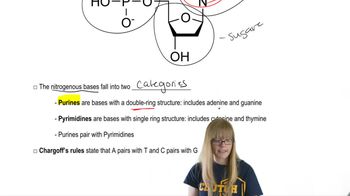
Purine
A double-ringed nitrogenous base found in DNA, specifically adenine or guanine, pairing with pyrimidines.
Pyrimidine
A single-ringed nitrogenous base in DNA, including cytosine and thymine, always pairing with purines.
Phosphodiester Bond
A covalent linkage connecting the sugar of one nucleotide to the phosphate of the next in a DNA strand.
Hydrogen Bond
A weak interaction stabilizing DNA by connecting complementary nitrogenous bases between strands.
Double Helix
A twisted ladder-like structure formed by two antiparallel DNA strands held together by hydrogen bonds.
Antiparallel Strands
Two DNA chains running in opposite 5' to 3' and 3' to 5' directions, enabling proper base pairing.
Major Groove
A wider region in the DNA double helix where more base pair interactions are accessible.
Minor Groove
A narrower region in the DNA double helix with fewer accessible base pair interactions.
Chargaff's Rules
A principle stating that adenine pairs with thymine and cytosine pairs with guanine in equal ratios.
 BackBack
 06:25
06:25