Skip to main content
Genetics
My Course
Learn
Exam Prep
AI Tutor
Study Guides
Textbook Solutions
Flashcards
Explore
Try the app
My Course
Learn
Exam Prep
AI Tutor
Study Guides
Textbook Solutions
Flashcards
Explore
Try the app
Back
Meiosis definitions
You can tap to flip the card.
Meiosis
You can tap to flip the card.
👆
Meiosis
A two-part cell division process producing four haploid cells from one diploid cell, crucial for sexual reproduction and genetic diversity.
Track progress
Control buttons has been changed to "navigation" mode.
1/15
Related flashcards
Related practice
Recommended videos
Meiosis quiz #1
Meiosis
40 Terms
Meiosis quiz #2
Meiosis
40 Terms
Meiosis quiz #3
Meiosis
40 Terms
Meiosis
9. Mitosis and Meiosis
7 problems
Topic
Kylia
Development of Animal Gametes
9. Mitosis and Meiosis
4 problems
Topic
Kylia
9. Mitosis and Meiosis
4 topics
10 problems
Chapter
Kylia
Guided course
05:30
Meiosis Overview
2583
views
35
rank
1
comments
Guided course
09:06
Meiosis Steps
2218
views
16
rank
3
comments
Terms in this set (15)
Hide definitions
Meiosis
A two-part cell division process producing four haploid cells from one diploid cell, crucial for sexual reproduction and genetic diversity.
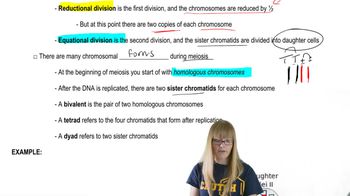
Reductional Division
The first meiotic division where chromosome number is halved, resulting in cells with one set of chromosomes.
Equatorial Division
The second meiotic division where sister chromatids are separated, producing cells with single chromosomes.
Homologous Chromosomes
Chromosome pairs with the same genes but possibly different alleles, one from each parent.
Sister Chromatids
Identical copies of a chromosome formed after DNA replication, joined at a centromere.
Bivalent
A structure formed by a pair of homologous chromosomes during meiosis, allowing crossing over.
Tetrad
A group of four chromatids formed by the pairing of two homologous chromosomes after replication.
Dyad
A pair of sister chromatids resulting from the separation of homologous chromosomes.
Synaptonemal Complex
A protein structure that forms between homologous chromosomes, facilitating their alignment and recombination.
Crossing Over
The exchange of genetic material between non-sister chromatids, increasing genetic variation.
Chiasmata
Visible connections where homologous chromosomes exchange genetic material during crossing over.
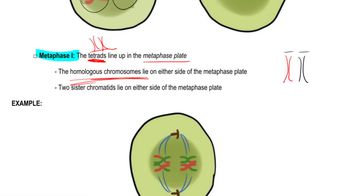
Metaphase Plate
An imaginary plane where chromosomes align during metaphase, ensuring proper segregation.
Disjunction
The proper separation of homologous chromosomes or sister chromatids during anaphase.
Nondisjunction
An error in chromosome separation, leading to cells with abnormal chromosome numbers and potential genetic disorders.
Haploid
A cell state with one set of chromosomes, typical of gametes after meiosis.
 BackBack
 05:30
05:30