Meiosis II in humans separates sister chromatids, resulting in four haploid cells.
What happens during prophase of meiosis I?
During prophase of meiosis I, chromatin condenses, homologous chromosomes pair (synapsis), and crossing over occurs.
Where does meiosis occur?
Meiosis occurs in germline cells, such as those in the ovaries and testes.
Do sister chromatids separate during meiosis I?
No, sister chromatids separate during meiosis II.
During meiosis, when does crossing over occur?
Crossing over occurs during Prophase I of meiosis.
When do the centromeres divide in meiosis?
Centromeres divide during Anaphase II of meiosis.
What is the role of the synaptonemal complex during prophase I of meiosis?
The synaptonemal complex forms to align homologous chromosomes, facilitating their pairing. This structure is crucial for the process of crossing over and genetic recombination.
What is disjunction and why is it important in meiosis I?
Disjunction is the proper separation of homologous chromosomes during anaphase I. It is important because errors in disjunction, called nondisjunction, can lead to genetic disorders.
How does the arrangement of chromosomes differ between metaphase I and metaphase II in meiosis?
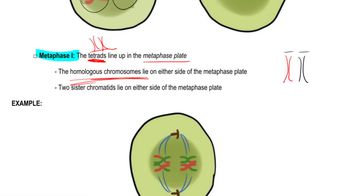
In metaphase I, homologous chromosomes line up on opposite sides of the metaphase plate, while in metaphase II, sister chromatids align at the metaphase plate. This difference ensures the correct segregation of genetic material in each division.
Why are cells considered haploid after meiosis I even if they contain two copies of each chromosome?
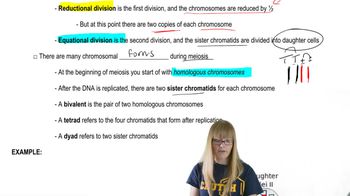
Cells are haploid after meiosis I because they contain only one type of each chromosome, regardless of the number of copies. The absence of homologous chromosome pairs defines their haploid status.
 Back
Back
 05:30
05:30